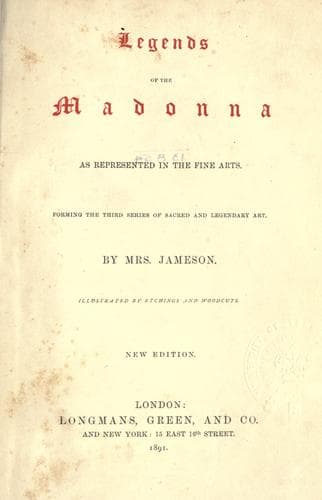
Legends of the Madonna as Represented in the Fine ArtsJameson, Mrs. (Anna)
Religion
Legends of the Madonna as Represented in the Fine Arts
Jameson, Mrs. (Anna)
Christian saints in art; Mary, Blessed Virgin, Saint -- Art; Mary, Blessed Virgin, Saint -- Legends
The wrath of Herod against the Magi of the East who had escaped from
his power, enhanced by his fears of the divine and kingly Infant,
occasioned the massacre of the Innocents, which led to the flight
of the Holy Family into Egypt. Of the martyred children, in their
character of martyrs, I have already spoken, and of their proper place
in a scheme of ecclesiastical decoration. There is surely something
very pathetic in that feeling which exalted these infant victims into
objects of religious veneration, making them the cherished companions
in heavenly glory of the Saviour for whose sake they were sacrificed
on earth. He had said, "Suffer little children to come unto me;"
and to these were granted the prerogatives of pain, as well as the
privileges of innocence. If, in the day of retribution, they sit at
the feet of the Redeemer, surely they will appeal against us, then and
there;--against us who, in these days, through our reckless neglect,
slay, body and soul, legions of innocents,--poor little unblest
creatures, "martyrs by the pang without the palm,"--yet dare to call
ourselves Christians.
* * * * *
The Massacre of the Innocents, as an event, belongs properly to the
life of Christ: it is not included in a series of the life of the
Virgin, perhaps from a feeling that the contrast between the most
blessed of women and mothers, and those who wept distracted for their
children, was too painful, and did not harmonize with the general
subject. In pictures of the Flight into Egypt, I have seen it
introduced allusively into the background; and in the architectural
decoration of churches dedicated to the Virgin Mother, as Notre Dame
de Chartres, it finds a place, but not often a conspicuous place;[1]
it is rather indicated than represented. I should pass over the
subject altogether, best pleased to be spared the theme, but
that there are some circumstances connected with it which require
elucidation, because we find them introduced incidentally into
pictures of the Flight and the _Riposo_.
[Footnote 1: It is conspicuous and elegantly treated over the door of
the Lorenz Kirche at Nuremberg.]
Thus, it is related that among the children whom Herod was bent on
destroying, was St. John the Baptist; but his mother Elizabeth fled
with him to a desert place, and being pursued by the murderers, "the
rock opened by a miracle, and close upon Elizabeth and her child;"
which means, as we may presume, that they took refuge in a cavern,
and were concealed within it until the danger was over. Zacharias,
refusing to betray his son, was slain "between the temple and the
altar," (Matt, xxiii. 35.) Both these legends are to be met with
in the Greek pictures, and in the miniatures of the thirteenth and
fourteenth centuries.[1]
[Footnote 1: They will be found treated at length in the artistic
subjects connected with St. John the Baptist.]
Public-domain text, read in full here on John Shaqi.
Reviews
Reviews
No reviews yet
Be the first to share your thoughts on this work.
Elsewhere in the archive
Join the Discussion
Join the discussion
Sign in to leave a comment or review.
Sign InorCreate an account