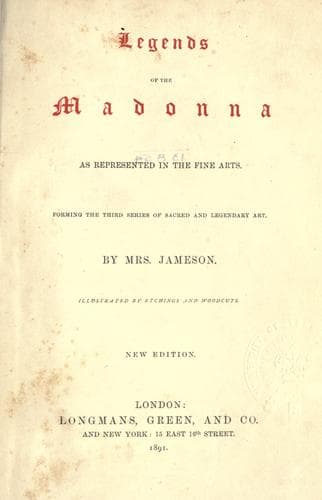
Legends of the Madonna as Represented in the Fine ArtsJameson, Mrs. (Anna)
Religion
Legends of the Madonna as Represented in the Fine Arts
Jameson, Mrs. (Anna)
Christian saints in art; Mary, Blessed Virgin, Saint -- Art; Mary, Blessed Virgin, Saint -- Legends
The subject of the Sleeping Christ is beautifully varied by the
introduction of St. John; as where Mary lifts the veil and shows her
Child to the little St. John, kneeling with folded hands: Raphael's
well-known "Vierge à la Diademe" is an instance replete with grace and
expression.[1] Sometimes Mary, putting her finger to her lip, exhorts
St. John to silence, as in a famous and oft-repeated subject by
Annibale Caracci, of which there is a lovely example at Windsor. Such
a group is called in Italian, _Il Silenzio_, and in French _le Sommeil
de Jésus_.
[Footnote 1: Louvre, 376. It is also styled _la Vierge au Linge_]
* * * * *
Another group of three figures consists of the Mother, the Child, and
St. Joseph as foster-father. This group, so commonly met with in the
later schools of art, dates from the end of the fifteenth century.
Gerson, an ecclesiastic distinguished at the Council of Constance for
his learning and eloquence, had written a poem of three thousand lines
in praise of St. Joseph, setting him up as the Christian, example
of every virtue; and this poem, after the invention of printing, was
published and widely disseminated. Sixtus IV. instituted a festival
in honour of the "Husband of the Virgin," which, as a novelty
and harmonizing with the tone of popular feeling, was everywhere
acceptable. As a natural consequence, the churches and chapels were
filled with pictures, which represented the Mother and her Child,
with Joseph standing or seated by, in an attitude of religious
contemplation or affectionate sympathy; sometimes leaning on his
stick, or with his tools lying beside him; and always in the old
pictures habited in his appropriate colours, the saffron-coloured robe
over the gray or green tunic.
In the Madonna and Child, as a strictly devotional subject, the
introduction of Joseph rather complicates the idea; but in the
domestic Holy Family his presence is natural and necessary. It is
seldom that he is associated with the action, where there is one;
but of this also there are some beautiful examples.
* * * * *
1. In a well-known composition by Raphael (Grosvenor Gal.), the mother
withdraws the covering from the Child, who seems to have that moment
awaked, and, stretching out his little arms, smiles in her face:
Joseph looks on tenderly and thoughtfully.
2. In another group by Raphael (Bridgewater Gal.), the Infant is
seated on the mother's knee, and sustained by part of her veil;
Joseph, kneeling, offers flowers to his divine foster-Son, who eagerly
stretches out his little hand to take them.
Public-domain text, read in full here on John Shaqi.
Reviews
Reviews
No reviews yet
Be the first to share your thoughts on this work.
Elsewhere in the archive
Join the Discussion
Join the discussion
Sign in to leave a comment or review.
Sign InorCreate an account