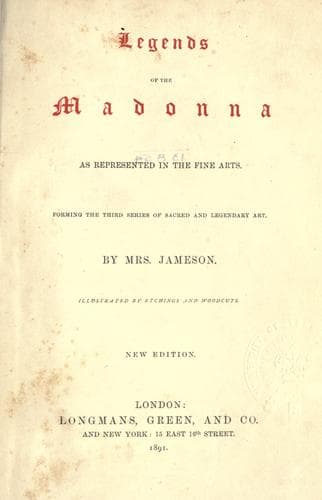
Legends of the Madonna as Represented in the Fine ArtsJameson, Mrs. (Anna)
Religion
Legends of the Madonna as Represented in the Fine Arts
Jameson, Mrs. (Anna)
Christian saints in art; Mary, Blessed Virgin, Saint -- Art; Mary, Blessed Virgin, Saint -- Legends
13. Rubens. Mary, seated on the ground, holds the Child with a
charming maternal expression, a little from her, gazing on him with
rapturous earnestness, while he looks up with responsive tenderness in
her face. His right hand rests on a cross presented by St. John, who
is presented by St. Elizabeth. Wonderful for the intensely natural and
domestic expression, and the beauty of the execution. (Florence, Pitti
Pal.)
14. D. Hopfer. Within the porch of a building, Mary is seated on one
side, reading intently. St. Anna, on the other side, holds out her
arms to the Child, who is sitting on the ground between them; an angel
looks in at the open door behind. (Bartsch., viii. 483.)
15. Rembrandt. (_Le Ménage du Menuisier_.) A rustic interior. Mary,
seated in the centre, is suckling her Child. St. Anna, a fat Flemish
grandame, has been reading the volume of the Scriptures, and bends
forward in order to remove the covering and look in the Infant's face.
A cradle is near. Joseph is seen at work in the background. (Louvre.)
16. Le Brun. (_The Benedicite_.) Mary, the Child, and Joseph, are
seated at a frugal repast. Joseph is in the act of reverently saying
grace, which gives to the picture the title by which it is known.[1]
[Footnote 1: Louvre, Ecole Française 57. There is a celebrated
engraving by Edelinck.]
* * * * *
It is distinctly related that Joseph brought up his foster-Son as a
carpenter, and that Jesus exercised the craft of his reputed father.
In the Church pictures, we do not often meet with this touching
and familiar aspect of the life of our Saviour. But in the small
decorative pictures painted for the rich ecclesiastics, and for
private oratories, and in the cheap prints which were prepared for
distribution among the people, and became especially popular during
the religious reaction of the seventeenth century, we find this
homely version of the subject perpetually, and often most pleasingly,
exhibited. The greatest and wisest Being who ever trod the earth was
thus represented, in the eyes of the poor artificer, as ennobling
and sanctifying labour and toil; and the quiet domestic duties
and affections were here elevated, and hallowed, by religious
associations, and adorned by all the graces of Art. Even where
the artistic treatment was not first-rate, was not such as the
painters--priests and poets as well as painters--of the fourteenth
and fifteenth centuries would have lent to such themes,--still if the
sentiment and significance were but intelligible to those especially
addressed, the purpose was accomplished, and the effect must have been
good.
Public-domain text, read in full here on John Shaqi.
Reviews
Reviews
No reviews yet
Be the first to share your thoughts on this work.
Elsewhere in the archive
Join the Discussion
Join the discussion
Sign in to leave a comment or review.
Sign InorCreate an account