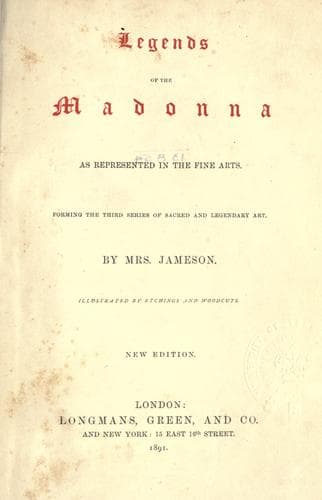
Legends of the Madonna as Represented in the Fine ArtsJameson, Mrs. (Anna)
Religion
Legends of the Madonna as Represented in the Fine Arts
Jameson, Mrs. (Anna)
Christian saints in art; Mary, Blessed Virgin, Saint -- Art; Mary, Blessed Virgin, Saint -- Legends
But those representations which come under our especial consideration
at present, are such as represent the moment in which Mary appears
before her Son. The earliest instance of this treatment is a group by
Giotto. Dante cites the deportment of the Virgin on this occasion, and
her mild reproach, "_con atto dolce di madre_," as a signal lesson of
gentleness and forbearance. (Purgatorio, c. xv.) It is as if he had
transferred the picture of Giotto into his Vision; for it is as a
picture, not an action, that it is introduced. Another, by Simon
Memmi, in the Roscoe Collection at Liverpool, is conceived in a
similar spirit. In a picture by Garofalo, Mary does not reproach her
Son, but stands listening to him with her hands folded on her bosom.
In a large and fine composition by Pinturicchio, the doctors throw
down their books before him, while the Virgin and Joseph are entering
on one side. The subject is conspicuous in Albert Durer's Life of
the Virgin, where Jesus is seated on high, as one having authority,
teaching from a chair like that of a professor in a university, and
surrounded by the old bearded doctors; and Mary stands before her Son
in an attitude of expostulation.
After the restoration of Jesus to his parents, they conducted him
home; "but his mother kept all these sayings in her heart." The return
to Nazareth, Jesus walking humbly between Joseph and Mary, was painted
by Rubens for the Jesuit College at Antwerp, as a lesson to youth.
Underneath is the text, "And he was subject unto them."[1]
[Footnote 1: It has been called by mistake "The Return from Egypt"]
THE DEATH OF JOSEPH.
_Ital._ La Morte di San Giuseppe. _Fr._ La Mort de St. Joseph _Ger._
Josef's Tod.
Between the journey to Jerusalem and the public appearance of Jesus,
chronologers place the death of Joseph, but the exact date is not
ascertained: some place it in the eighteenth year of the life of our
Saviour, and others in his twenty-seventh year, when, as they assert,
Joseph was one hundred and eleven years old.
Public-domain text, read in full here on John Shaqi.
Reviews
Reviews
No reviews yet
Be the first to share your thoughts on this work.
Elsewhere in the archive
Join the Discussion
Join the discussion
Sign in to leave a comment or review.
Sign InorCreate an account