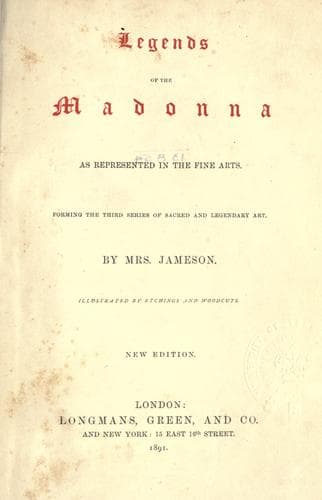
Legends of the Madonna as Represented in the Fine ArtsJameson, Mrs. (Anna)
Religion
Legends of the Madonna as Represented in the Fine Arts
Jameson, Mrs. (Anna)
Christian saints in art; Mary, Blessed Virgin, Saint -- Art; Mary, Blessed Virgin, Saint -- Legends
Zani has noticed the impropriety here, and in other instances, of
exhibiting the "_Grandissima Donna_" as prostrate, and in a state
of insensibility; a style of treatment which, in more ancient times,
would have been inadmissible. The idea embodied by the artist should
be that which Bishop Taylor has _painted_ in words:--"By the cross
stood the holy Virgin Mother, upon whom old Simeon's prophecy was now
verified; for now she felt a sword passing through her very soul.
She stood without clamour and womanish noises sad, silent, and with
a modest grief, deep as the waters of the abyss, but smooth as the
face of a pool; full of love, and patience, and sorrow, and hope!"
To suppose that this noble creature lost all power over her emotions,
lost her consciousness of the "high affliction" she was called to
suffer, is quite unworthy of the grand ideal of womanly perfection
here placed before us. It is clear, however, that in the later
representations, the intense expression of maternal anguish in the
hymn of the Stabat Mater gave the key to the prevailing sentiment.
And as it is sometimes easier to faint than to endure; so it was
easier for certain artists to express the pallor and prostration of
insensibility, than the sublime faith and fortitude which in that
extremest hour of trial conquered even a mother's unutterable woe.
That most affecting moment, in which the dying Saviour recommends his
Mother to the care of the best beloved of his disciples, I have never
seen worthily treated. There are, however, some few Crucifixions in
which I presume the idea to have been indicated; as where the Virgin
stands leaning on St. John, with his sustaining arm reverently round
her, and both looking up to the Saviour, whose dying face is turned
towards them. There is an instance by Albert Durer (the wood-cut
in the "Large Passion"); but the examples are so few as to be
exceptional.
* * * * *
Public-domain text, read in full here on John Shaqi.
Reviews
Reviews
No reviews yet
Be the first to share your thoughts on this work.
Elsewhere in the archive
Join the Discussion
Join the discussion
Sign in to leave a comment or review.
Sign InorCreate an account