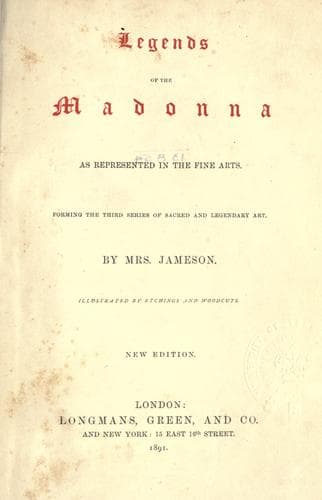
Legends of the Madonna as Represented in the Fine ArtsJameson, Mrs. (Anna)
Religion
Legends of the Madonna as Represented in the Fine Arts
Jameson, Mrs. (Anna)
Christian saints in art; Mary, Blessed Virgin, Saint -- Art; Mary, Blessed Virgin, Saint -- Legends
In a beautiful small composition, a print, attributed to Albert Durer,
there are only three figures. Joseph of Arimathea stands on a ladder,
and detaches from the cross the dead form of the Saviour, who is
received into the arms of his Mother. This is a form of the _Mater
Dolorosa_ which is very uncommon, and must be regarded as exceptional,
and ideal, unless we are to consider it as a study and an incomplete
group.
* * * * *
The DEPOSITION is properly that moment which succeeds the DESCENT from
the Cross; when the dead form of Christ is deposed or laid upon the
ground, resting on the lap of his Mother, and lamented by St. John,
the Magdalene, and others. The ideal and devotional form of this
subject, styled a Pietà, may be intended to represent one of those
festivals of the Passion Week which commemorate the participation of
the holy Virgin Mother in the sufferings of her Son.[1] I have already
spoken at length of this form of the Mater Dolorosa; the historical
version of the same subject is what we have now to consider, but only
so far as regards the figure of the Virgin.
[Footnote 1: "C'est ce que l'on a jugé à propos d'appeler _La
Compassion_ de la Vierge, autrement _Notre Dame de Pitié_."--Vide
_Baillet_, "Les Fêtes Mobiles."]
In a Deposition thus dramatically treated, there are always from four
to six or eight figures. The principal group consists of the dead
Saviour and his Mother. She generally holds him embraced, or bends
over him contemplating his dead face, or lays her cheek to his with
an expression of unutterable grief and love: in the antique conception
she is generally fainting; the insensibility, the sinking of the whole
frame through grief, which in the Crucifixion is misplaced, both in
regard to the religious feeling and the old tradition, is here quite
proper.[1] Thus she appears in the genuine Greek and Greco-Italian
productions of the thirteenth and fourteenth centuries, as well as in
the two finest examples that could be cited in more modern times.
[Footnote 1: The reason given is curious:--"_Perchè quando Gesù pareva
tormentato essendo vivo, il dolore si partiva frà la santissima madre
e lui; ma quando poi egli era morto, tutto il dolore rimaneva per la
sconsolata madre._"]
1. In an exquisite composition by Raphael, usually styled a Pietà,
but properly a Deposition, there are six figures: the extended form
of Christ; the Virgin swooning in the arms of Mary Salome and Mary
Cleophas; Mary Magdalene sustains the feet of Christ, while her sister
Martha raises the veil of the Virgin, as if to give her air; St. John
stands by with clasped hands; and Joseph of Arimathea looks on the
sorrowing group with mingled grief and pity.[1]
[Footnote 1: This wonderful drawing (there is no _finished_ picture)
was in the collection of Count Fries, and then belonged to Sir T.
Lawrence. There is a good engraving by Agricola.]
Public-domain text, read in full here on John Shaqi.
Reviews
Reviews
No reviews yet
Be the first to share your thoughts on this work.
Elsewhere in the archive
Join the Discussion
Join the discussion
Sign in to leave a comment or review.
Sign InorCreate an account