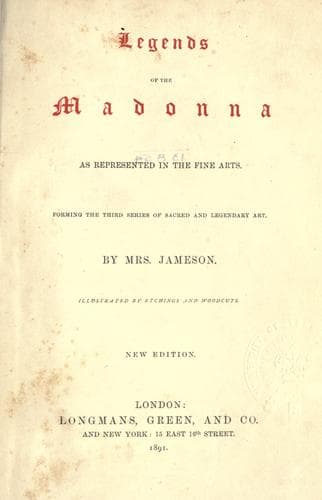
Legends of the Madonna as Represented in the Fine ArtsJameson, Mrs. (Anna)
Religion
Legends of the Madonna as Represented in the Fine Arts
Jameson, Mrs. (Anna)
Christian saints in art; Mary, Blessed Virgin, Saint -- Art; Mary, Blessed Virgin, Saint -- Legends
In early art, particularly in the Gothic sculpture, two or more of
these subjects are generally grouped together. Sometimes we have the
death-scene and the entombment on a line below, and, above these,
the coronation or the assumption, as over the portal of Notre Dame at
Paris, and in many other instances; or we have first her death, above
this, her assumption, and, above all, her coronation; as over the
portal at Amiens and elsewhere.
* * * * *
I shall now take these subjects in their order.
The angel announcing to Mary her approaching death has been rarely
treated. In general, Mary is seated or standing, and the angel kneels
before her, bearing the starry palm brought from Paradise. In the
frescoes at Orvieto, and in the bas-relief of Oreagna,[1] the angel
comes flying downwards with the palm. In a predella by Fra Filippo
Lippi, the angel kneels, reverently presenting a taper, which the
Virgin receives with majestic grace; St. Peter stands behind. It was
the custom to place a taper in the hand of a dying person; and as the
palm is also given sometimes to the angel of the incarnation, while
the taper can have but one meaning, the significance of the scene
is here fixed beyond the possibility of mistake, though there is a
departure from the literal details of the old legend. There is in
the Munich Gallery a curious German example of this subject by Hans
Schauffelein.
[Footnote 1: On the beautiful shrine in Or-San-Michele, at Florence.]
* * * * *
The death of the Virgin is styled in Byzantine and old Italian art
the Sleep of the Virgin, _Il Sonno della Madonna_; for it was an
old superstition, subsequently rejected as heretical, that she did
not really die after the manner of common mortals, only fell asleep
till her resurrection. Therefore, perhaps, it is, that in the early
pictures we have before us, not so much a scene or action, as a sort
of mysterious rite; it is not the Virgin dead or dying in her bed; she
only slumbers in preparation for her entombment; while in the later
pictures, we have a death-bed scene with all the usual dramatic and
pathetic accessories.
In one sense or the other, the theme has been constantly treated,
from the earliest ages of the revival of art down to the seventeenth
century.
In the most ancient examples which are derived from the Greek school,
it is always represented with a mystical and solemn simplicity,
adhering closely to the old legend, and to the formula laid down in
the Greek Manual.
Public-domain text, read in full here on John Shaqi.
Reviews
Reviews
No reviews yet
Be the first to share your thoughts on this work.
Elsewhere in the archive
Join the Discussion
Join the discussion
Sign in to leave a comment or review.
Sign InorCreate an account