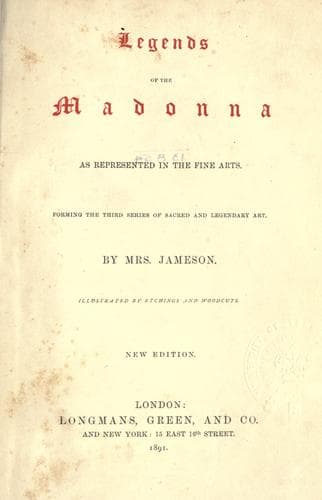
Legends of the Madonna as Represented in the Fine ArtsJameson, Mrs. (Anna)
Religion
Legends of the Madonna as Represented in the Fine Arts
Jameson, Mrs. (Anna)
Christian saints in art; Mary, Blessed Virgin, Saint -- Art; Mary, Blessed Virgin, Saint -- Legends
The first is purely ideal and devotional; it is simply the expression
of a dogma of faith, "_Assumpta est Maria Virgo in Coelum_." The
figure of the Virgin is seen within an almond-shaped aureole (the
mandorla), not unfrequently crowned as well as veiled, her hands
joined, her white robe falling round her feet (for in all the early
pictures the dress of the Virgin is white, often spangled with stars),
and thus she seems to cleave the air upwards, while adoring angels
surround the glory of light within which she is enshrined. Such are
the figures which are placed in sculpture over the portals of the
churches dedicated to her, as at Florence.[1] She is not always
standing and upright, but seated on a throne, placed within an aureole
of light, and borne by angels, as over the door of the Campo Santo
at Pisa. I am not sure that such figures are properly styled the
Assumption; they rather exhibit in an ideal form the glorification
of the Virgin, another version of the same idea expressed in the
_Incoronata_. She is here _Varia Virgo Assumpta_, or, in Italian,
_L'Assunta_; she has taken upon her the glory of immortality, though
not yet crowned.
[Footnote 1: The "Santa Maria del Fiore,"--the Duomo.]
But when the Assumption is presented to us as the final scene of her
life, and expresses, as it were, a progressive action--when she has
left the empty tomb, and the wondering, weeping apostles on the earth
below, and rises "like the morning" ("_quasi aurora surgens_") from
the night of the grave,--then we have the Assumption of the Virgin in
its dramatic and historical form, the final act and consummation of
her visible and earthly life. As the Church had never settled in what
manner she was translated into heaven, only pronouncing it heresy to
doubt the fact itself, the field was in great measure left open to the
artists. The tomb below, the figure of the Virgin floating in mid-air,
and the opening heavens above, such is the general conception fixed
by the traditions of art; but to give some idea of the manner in which
this has been varied, I shall describe a few examples.
1. Giunta Pisano, 1230. (Assisi, S. Franceso.) Christ and the Virgin
ascend together in a seated attitude upborne by clouds and surrounded
by angels; his arm is round her. The empty tomb, with the apostles and
others, below. The idea is here taken from the Canticles (ch. viii.),
"Who is this that ariseth from the wilderness leaning upon her
beloved?"
Public-domain text, read in full here on John Shaqi.
Reviews
Reviews
No reviews yet
Be the first to share your thoughts on this work.
Elsewhere in the archive
Join the Discussion
Join the discussion
Sign in to leave a comment or review.
Sign InorCreate an account