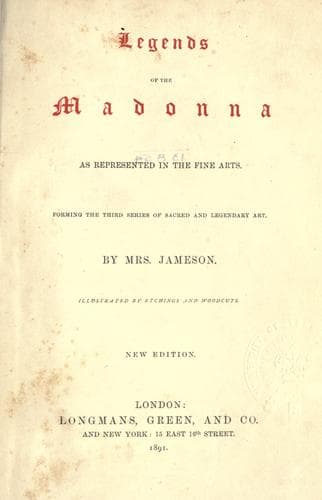
Legends of the Madonna as Represented in the Fine ArtsJameson, Mrs. (Anna)
Religion
Legends of the Madonna as Represented in the Fine Arts
Jameson, Mrs. (Anna)
Christian saints in art; Mary, Blessed Virgin, Saint -- Art; Mary, Blessed Virgin, Saint -- Legends
The exact date of the frescoes executed by Agnolo Gaddi is not known,
but, according to Vasari, he was called to Prato _after_ 1348. An
inscription in the chapel refers them to the year 1390, a date too
late to be relied on. The story of Michele di Prato I have never seen
elsewhere; but just as the vicinity of Cologne, the shrine of the
"Three Kings," had rendered the Adoration of the Magi one of the
popular themes in early German and Flemish art; so the vicinity of
Prato rendered the legend of St. Thomas a favourite theme of the
Florentine school, and introduced it wherever the influence of that
school had extended. The fine fresco by Mainardi, in the Baroncelli
Chapel, is an instance; and I must cite one yet finer, that by
Ghirlandajo in the choir of S. Maria-Novella: in this last-mentioned
example, the Virgin stands erect in star-bespangled drapery and
closely veiled.
We now proceed to other examples of the treatment of the Assumption.
3. Taddeo Bartoli, 1413. He has represented the moment in which the
soul is reunited to the body. Clothed in a starry robe she appears in
the very act and attitude of one rising up from a reclining position,
which is most beautifully expressed, as if she were partly lifted
up upon the expanded many-coloured wings of a cluster of angels, and
partly drawn up, as it were, by the attractive power of Christ, who,
floating above her, takes her clasped hands in both his. The intense,
yet tender ecstasy in _her_ face, the mild spiritual benignity in
_his_, are quite indescribable, and fix the picture in the heart and
the memory as one of the finest religious conceptions extant. (Siena,
Palazzo Publico.)
I imagine this action of Christ taking her hands in both his, must be
founded on some ancient Greek model, for I have seen the same _motif_
in other pictures, German and Italian; but in none so tenderly or so
happily expressed.
4. Domenico di Bartolo, 1430. A large altar-piece. Mary seated on a
throne, within a glory of encircling cherubim of a glowing red, and
about thirty more angels, some adoring, others playing on musical
instruments, is borne upwards. Her hands are joined in prayer, her
head veiled and crowned, and she wears a white robe, embroidered
with golden flowers. Above, in the opening heaven, is the figure of
Christ, young and beardless (_à l'antique_), with outstretched arms,
surrounded by the spirits of the blessed. Below, of a diminutive
size, as if seen from a distant height, is the tomb surrounded by
the apostles, St. Thomas holding the girdle. This is one of the most
remarkable and important pictures of the Siena school, out of Siena,
with which I am acquainted. (Berlin Gal., 1122.)
5. Ghirlandajo, 1475. The Virgin stands in star-spangled drapery, with
a long white veil, and hands joined, as she floats upwards. She is
sustained by four seraphim. (Florence, S. Maria-Novella.)
Public-domain text, read in full here on John Shaqi.
Reviews
Reviews
No reviews yet
Be the first to share your thoughts on this work.
Elsewhere in the archive
Join the Discussion
Join the discussion
Sign in to leave a comment or review.
Sign InorCreate an account