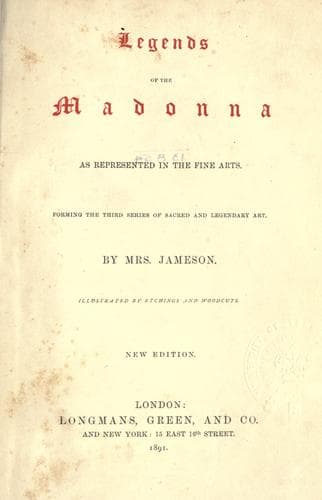
Legends of the Madonna as Represented in the Fine ArtsJameson, Mrs. (Anna)
Religion
Legends of the Madonna as Represented in the Fine Arts
Jameson, Mrs. (Anna)
Christian saints in art; Mary, Blessed Virgin, Saint -- Art; Mary, Blessed Virgin, Saint -- Legends
But about the middle of the thirteenth century, and contemporary with
Cimabue, we find the first indication of a departure, even in the
mosaics, from the lifeless, formal type of Byzantine art. The earliest
example of a more animated treatment is, perhaps, the figure in the
apsis of St. John Lateran. (Rome.) In the centre is an immense cross,
emblem of salvation; the four rivers of Paradise (the four Gospels)
flow from its base; and the faithful, figured by the hart and the
sheep, drink from these streams. Below the cross is represented, of
a small size, the New Jerusalem guarded by an archangel. On the right
stands the Virgin, of colossal dimensions. She places one hand on the
head of a diminutive kneeling figure, Pope Nicholas IV.,[1] by whom
the mosaic was dedicated about 1290; the other hand, stretched forth,
seems to recommend the votary to the mercy of Christ.
[Footnote 1: For a minute reduction of the whole composition, see
Kugler's Handbook, p. 113.]
Full-length effigies of the Virgin seated on a throne, or glorified as
queen of heaven, or queen of angels, without her divine Infant in her
arms, are exceedingly rare in every age; now and then to be met with
in the early pictures and illuminations, but never, that I know of,
in the later schools of art. A signal example is the fine enthroned
Madonna in the Campo Santo, who receives St. Ranieri when presented
by St. Peter and St. Paul.
On the Dalmatica (or Deacon's robe) preserved in the sacristy of
St. Peter's at Rome (which Lord Lindsay well describes as a perfect
example of the highest style of Byzantine art) (Christian Art, i.
136), the embroidery on the front represents Christ in a golden circle
or glory, robed in white, with the youthful and beardless face, his
eyes looking into yours. He sits on the rainbow; his left hand holds
an open book, inscribed, "Come, ye blessed of my Father!" while
the right is raised in benediction. The Virgin stands on the right
entirely _within_ the glory; "she is sweet in feature and graceful
in attitude, in her long white robe." The Baptist stands on the left
_outside_ the glory.
In pictures representing the glory of heaven, Paradise, or the Last
Judgment, we have this idea constantly repeated--of the Virgin on the
right hand of her Son, but not on the same throne with him, unless it
be a "Coronation," which is a subject apart.
Public-domain text, read in full here on John Shaqi.
Reviews
Reviews
No reviews yet
Be the first to share your thoughts on this work.
Elsewhere in the archive
Join the Discussion
Join the discussion
Sign in to leave a comment or review.
Sign InorCreate an account