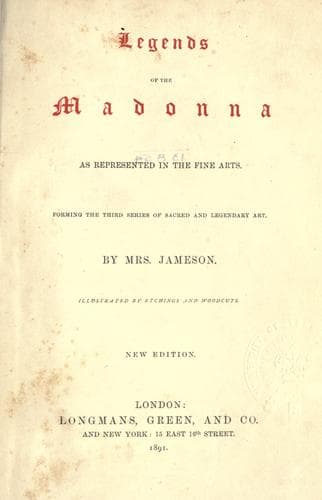
Legends of the Madonna as Represented in the Fine ArtsJameson, Mrs. (Anna)
Religion
Legends of the Madonna as Represented in the Fine Arts
Jameson, Mrs. (Anna)
Christian saints in art; Mary, Blessed Virgin, Saint -- Art; Mary, Blessed Virgin, Saint -- Legends
The numerous--often most beautiful--heads and half-length figures
which represent the Virgin alone, looking up with a devout or tender
expression, or with the head declined, and the hands joined in prayer,
or crossed over the bosom with virginal humility and modesty, belong
to this class of representations. In the ancient heads, most of which
are imitations of the old Greek effigies ascribed to St. Luke, there
is often great simplicity and beauty. When she wears the crown over
her veil, or bears a sceptre in her hand, she figures as the queen of
heaven (_Regina Coeli_). When such effigies are attended by adoring
angels, she is the queen of angels (_Regina Angelorum_). When she is
weeping or holding the crown of thorns, she is Our Lady of Sorrow, the
_Mater Dolorosa_. When she is merely veiled, with folded hands, and
in her features all the beauty, maiden purity, and sweetness which the
artist could render, she is simply the Blessed Virgin, the Madonna,
the _Santa Maria Vergine_. Such heads are very rare in the earlier
schools of art, which seldom represented the Virgin without her
Child, but became favourite studies of the later painters, and
were multiplied and varied to infinitude from the beginning of the
seventeenth century. From these every trace of the mystical and solemn
conception of antiquity gradually disappeared; till, for the majestic
ideal of womanhood, we have merely inane prettiness, or rustic, or
even meretricious grace, the borrowed charms of some earthly model.
L'INCORONATA.
The Coronation of the Virgin. _Lat._ Coronatio Beatæ Mariæ Virginis.
_Ital._ Maria coronata dal divin suo Figlio. _Fr._ Le Couronnement de
la Sainte Vierge. _Ger._ Die Krönung Mariä.
The usual type of the Church triumphant is the CORONATION OF THE
VIRGIN properly so called, Christ in the act of crowning his Mother;
one of the most popular, significant, and beautiful subjects in the
whole range of mediæval art.
When in a series of subjects from the life of the Virgin, so often
met with in religious prints and in the Roman Catholic churches, we
find her death and her assumption followed by her coronation; when
the bier or sarcophagus and the twelve apostles appear below, while
heaven opens upon us above; then the representation assumes a kind
of dramatic character: it is the last and most glorious event of her
history. The Mother, dying on earth, is received into glory by her Son
who had gone before her, and who thus celebrates the consummation of
his victory and hers.
Public-domain text, read in full here on John Shaqi.
Reviews
Reviews
No reviews yet
Be the first to share your thoughts on this work.
Elsewhere in the archive
Join the Discussion
Join the discussion
Sign in to leave a comment or review.
Sign InorCreate an account