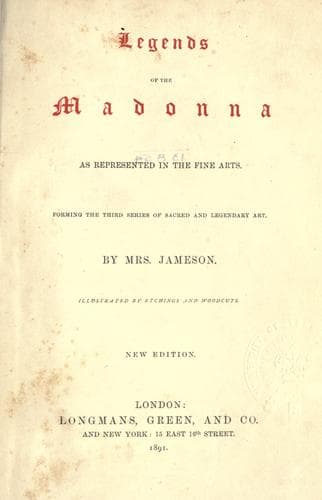
Legends of the Madonna as Represented in the Fine ArtsJameson, Mrs. (Anna)
Religion
Legends of the Madonna as Represented in the Fine Arts
Jameson, Mrs. (Anna)
Christian saints in art; Mary, Blessed Virgin, Saint -- Art; Mary, Blessed Virgin, Saint -- Legends
We must be careful to discriminate between the Conception, so
styled by ecclesiastical authority, and that singular and mystical
representation which is sometimes called the "Predestination of Mary,"
and sometimes the "Litanies of the Virgin." Collectors and writers
on art must bear in mind, that the former, as a subject, dates only
from the beginning of the seventeenth century, the latter from
the beginning of the sixteenth. Although, as representations, so
very similar, yet the intention and meaning are different. In the
Conception it is the sinless Virgin in her personal character, who
is held up to reverence, as the purest, wisest, holiest, of created
beings. The earlier theme involves a yet more recondite signification.
It is, undoubtedly, to be regarded as an attempt on the part of the
artist to express, in a visible form, the idea or promise of the
redemption of the human race, as existing in the Sovereign Mind before
the beginning of things. They do not personify this idea under the
image of Christ,--for they conceived that, as the second person of the
Trinity, he could not be his own instrument,--but by the image of Mary
surrounded by those attributes which were afterwards introduced into
the pictures of the Conception: or setting her foot, as second Eve, on
the head of the prostrate serpent. Not seldom, in a series of subjects
from the Old Testament, the _pendant_ to Eve holding the apple is Mary
crushing the head of the fiend; and thus the "bane and antidote are
both before us." This is the proper interpretation of those effigies,
so prevalent in every form of art during the sixteenth century, and
which are often, but erroneously, styled the Immaculate Conception.
The numerous heads of the Virgin which proceeded from the later
schools of Italy and Spain, wherein she appears neither veiled nor
crowned, but very young, and with flowing hair and white vesture, are
intended to embody the popular idea of the _Madonna purissima_, of
"the Virgin most pure, conceived without sin," in an abridged form.
There is one by Murillo, in the collection of Mr. Holford; and another
by Guido, which will give an idea of the treatment.
Before quitting the subject of the Immaculate Conception. I must
refer to a very curious picture[1] called an Assumption, but certainly
painted at least one hundred years before the Immaculate Conception
was authorized as a Church subject.
[Footnote 1: Once in the collection of Mr. Solly, and now in the
possession of Mr. Bromley of Wootten.]
Public-domain text, read in full here on John Shaqi.
Reviews
Reviews
No reviews yet
Be the first to share your thoughts on this work.
Elsewhere in the archive
Join the Discussion
Join the discussion
Sign in to leave a comment or review.
Sign InorCreate an account