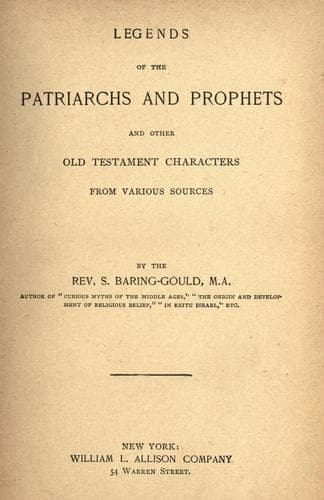
Legends of the Patriarchs and Prophets: And Other Old Testament Characters from Various SourcesBaring-Gould, S. (Sabine)
Religion
Legends of the Patriarchs and Prophets: And Other Old Testament Characters from Various Sources
Baring-Gould, S. (Sabine)
Bible. Old Testament -- Legends
Kanuch cried out for assistance, and fled to the king, who sent men to
set up the image, and replace on its head the crown that had fallen
from it.
But doubt took possession of the heart of Kanuch; he no longer
addressed the image in prayer, and his enthusiasm was at an end. The
king observed this, and sent two vizirs with orders to imprison and
execute him. But Allah struck the vizirs with blindness, and he sent
two angels to transport Kanuch to a well-shaded grotto, well supplied
with all that could content the heart of man.
As Kanuch was nowhere to be found, the king appointed his kinsman Davud
to be high priest. But on the third day he came to the king to announce
to him that the idol was again prostrate.
The monarch set it up once more, and Eblis, entering the image, spoke
through its mouth, exhorting all men to beware of novel doctrines which
were about to be introduced.
Next feast-day Davud was about to sacrifice two oxen to the idol, when
one of them opened its mouth, and thus addressed him:--
“Will you sacrifice creatures endued with life by the living God to a
mass of lifeless metal? O God, do thou destroy this sinful nation!” And
the oxen broke their halters, and ran away.
Horsemen were deputed to pursue and capture them, but they escaped, for
Allah screened them.
But God in his mercy resolved to give the Thamudites another chance of
repenting of their idolatry.
Raghwah, Kanuch’s wife, had shed incessant tears since the
disappearance of her husband. Allah despatched a bird out of Paradise
to guide her to the grotto of Kanuch.
This bird was a raven; its head was white as snow, its back was green
as emerald. Its feet were purple; its beak of heaven’s blue. Its eyes
were gems; only its body was black, for this bird did not fall under
the curse of Noah, as it was in Paradise.
It was midnight when the raven entered Raghwah’s dark chamber, where
she lay weeping on a carpet; but the glory of its eyes illumined the
whole room, as though the sun had suddenly flashed into it. Raghwah
rose from her place, and gazed in wonder on the lovely bird, which
opened its beak and said, “Arise and follow me! God has seen thy tears,
and will reunite thee to thy husband.”
Raghwah followed the raven, which flew before her, and with the light
of its eyes turned the night into day. The morning star had not risen,
when they stood before Kanuch’s grot. Then cried the raven, “Kanuch,
open to thy wife!” and so vanished.
Nine months after that Raghwah had rejoined her husband, she bore him
a son, who was the image of Seth, and had on his brow the prophetic
light; and Kanuch, in the hope of drawing him to the knowledge of the
true God and to a pious life, gave him the name of Saleh (The Blessed).
Not long after Saleh’s birth, Kanuch died; and the raven of Paradise
returned to the grotto to lead back Saleh to his own people.
Saleh grew in beauty and strength, to the admiration of his mother and
all who saw him.
Public-domain text, read in full here on John Shaqi.
Reviews
Reviews
No reviews yet
Be the first to share your thoughts on this work.
Elsewhere in the archive
Join the Discussion
Join the discussion
Sign in to leave a comment or review.
Sign InorCreate an account