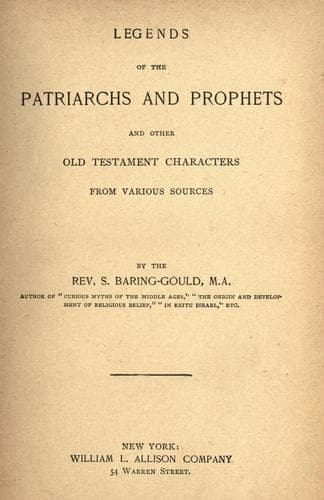
Legends of the Patriarchs and Prophets: And Other Old Testament Characters from Various SourcesBaring-Gould, S. (Sabine)
Religion
Legends of the Patriarchs and Prophets: And Other Old Testament Characters from Various Sources
Baring-Gould, S. (Sabine)
Bible. Old Testament -- Legends
Shortly after, Terah’s wife was pregnant; she concealed her situation
as long as was possible, pretending that she was ill; but when she
could conceal it no more, the infant crept behind her breasts, so that
she appeared to every eye as if nothing were about to take place.
When the time came for her delivery, she went in fear out of the city,
and wandered in the desert till she lighted on a cave, into which she
entered. Next morning she was delivered of a son, Abraham, whose face
shone, so that the grotto was as light as though the sun were casting
a golden beam into it. She wrapped the child in a mantle, and left it
there to the custody of God and His angels, and returned home. God
heard the cry of the weeping infant, and He sent His angel Gabriel
to the cave, who let the child suck milk out of his fore-finger. But
according to another account he opened two holes in the cave, from
which dropped oil and flour to nourish Abraham. Others, however, say
that Terah visited the cave every day, and nursed and fed the child.
According to the Arab tradition, which follows the Jewish in most
particulars, the mother, on visiting the cave, found the infant sucking
its two thumbs. Now out of one of its thumbs flowed milk, and out of
the other, honey, and thus the babe nourished itself: or, say others,
from one finger flowed water when he sucked it; from a second, milk;
from a third, honey; from a fourth, the juice of dates; and from the
little finger, butter.[297]
When Abraham had been in the cave, according to some, three years,
according to others ten, and according to others thirteen, he left the
cavern and stood on the face of the desert. And when he saw the sun
shining in all its glory, he was filled with wonder, and he thought,
“Surely the sun is God the Creator!” and he knelt down and worshipped
the sun. But when evening came, the sun went down in the west, and
Abraham said, “No! the Author of creation cannot set.” Now the moon
arose in the east, and the stars looked out of the firmament. Then
said Abraham, “This moon must indeed be God, and all the stars are His
host!” And kneeling down he adored the moon.
But after some hours of darkness the moon set, and from the east
appeared once more the bright face of the sun. Then said Abraham,
“Verily these heavenly bodies are no gods, for they obey law: I will
worship Him who imposed the law upon them.”
The Arab story is this. When Abraham came out of the cave, he saw a
number of flocks and herds, and he said to his mother, “Who is lord of
these?” She answered, “Your father Azar (Terah).” “And who is the lord
of Azar?” he further asked. She replied, “Nimrod.” “And who is the lord
of Nimrod?” “Oh, hush, my son,” said she, striking him on the mouth;
“you must not push your questions so far.” But it was by following this
train of thought that Abraham arrived at the knowledge of the one true
God.
Public-domain text, read in full here on John Shaqi.
Reviews
Reviews
No reviews yet
Be the first to share your thoughts on this work.
Elsewhere in the archive
Join the Discussion
Join the discussion
Sign in to leave a comment or review.
Sign InorCreate an account