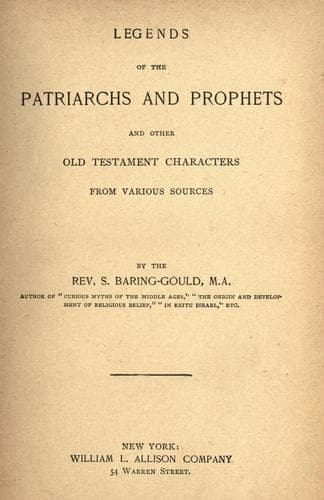
Legends of the Patriarchs and Prophets: And Other Old Testament Characters from Various SourcesBaring-Gould, S. (Sabine)
Religion
Legends of the Patriarchs and Prophets: And Other Old Testament Characters from Various Sources
Baring-Gould, S. (Sabine)
Bible. Old Testament -- Legends
Now on the morrow, to the royal court,
Terah Ben-Nahor from old Ur was brought--
Protesting loud he would not yield his son
As slave, at any price, to any one.
“My flesh and blood be sold!
Fie on you! Do you reckon that I prize
My first-begotten as mere merchandise,
To barter him for gold!
A curse on him who would the old man’s stay,
That bears him up, with money buy away!
Require me not to offer child of mine
To serve and brim a tyrant’s cup with wine;
To waste a life from morning to its grave,
Branded in mind and soul and body ‘Slave!’
How could I be repaid?
His artless fondlings, all his childish ways:
The reminiscences of olden days,
That sudden flash and fade,
Of her who bore him--her, my boyhood’s choice--
Resemblances in feature, figure, voice,
In gesture, manner, ay! in very tone
Of pealing laugh, of that dear partner gone?
Thou, Nimrod, to an old man condescend
To hear his story; your attention lend,
And judge if acted well.
Last year to me thou gav’st a goodly steed,
From thine own stud, of purest Yemen breed:
And thus it me befel.
A stranger offered me a price so fair
That I accepted it, and sold the mare.”
“My gift disposed of!” with an angry start,
King Nimrod thundered: “Thou, old man, shalt smart
For this thy avarice. A royal gift,
Thou knowest well, must never owners shift,
As thing of little worth.”
Then Terah raised his trembling hands, and said,
“From thine own mouth, O King has judgment sped.
The Lord of Heaven and Earth,
The King of Kings to me my offspring gave,
And shall I sell His gift to be a slave?
Nimrod! that child, which is His royal gift,--
Thy mouth hath said it,--may not owners shift.”
At this time idolatry was commonly practised by all. Nimrod and his
servants Terah and his whole house worshipped images of wood and stone.
Terah had not only twelve idols of the twelve months which he adored,
but he manufactured images and sold them.
One day, when Terah was absent, and Abraham was left to manage the
shop, he thought the time had come when he must make his protest
against idolatry. This he did as follows. Every purchaser who came,
was asked by Abraham his age; if he answered fifty or sixty years old,
Abraham exclaimed, “Woe to a man of such an age who adores the work of
one day!” and the purchaser withdrew in shame.
Another version of the incident is more full.
A strong, lusty fellow came one day to buy an idol, the strongest that
there was. As he was going away with it, Abraham called after him, “How
old are you?”
“Seventy years,” he answered.
“Oh, you fool!” said Abraham, “to adore a god younger than yourself.”
“What do you mean?” asked the purchaser.
“Why, you were born seventy years ago, and this god was made only
yesterday.”
Hearing this, the buyer threw the idol away.
Public-domain text, read in full here on John Shaqi.
Reviews
Reviews
No reviews yet
Be the first to share your thoughts on this work.
Elsewhere in the archive
Join the Discussion
Join the discussion
Sign in to leave a comment or review.
Sign InorCreate an account