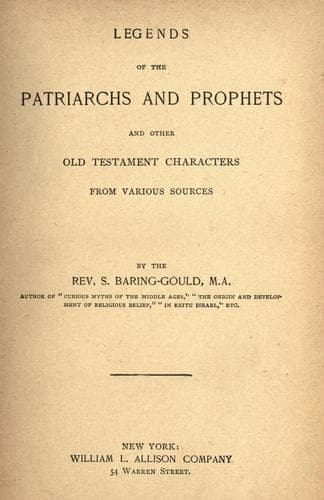
Legends of the Patriarchs and Prophets: And Other Old Testament Characters from Various SourcesBaring-Gould, S. (Sabine)
Religion
Legends of the Patriarchs and Prophets: And Other Old Testament Characters from Various Sources
Baring-Gould, S. (Sabine)
Bible. Old Testament -- Legends
Nimrod believing what was said, sent a servant to assassinate Abraham.
But Eliezer, the slave, whom Nimrod had given to the patriarch, had
been with the councillors when this advice was given, and he fled and
told Abraham before the emissary of the tyrant arrived; and Abraham
left his house and took refuge with Noah and Shem, and remained hidden
with them for the space of one month.
Here Terah sought him in secret; and Abraham addressed him a long
discourse on the vanity of idol-worship and the evil of serving the
godless tyrant Nimrod. And Noah and Shem supported him.
Then Terah, who grieved over the death of his son Haran, consented to
all that Abraham had said, and he went forth with Abraham and his wife
Sarah, and Lot his grandson, the son of Haran, and all his household,
and they settled at Charan, where the land was fruitful and well
watered. The dwellers in Charan associated themselves with Abraham, who
instructed them in the knowledge and fear of the Lord.
2. THE CALL OF ABRAHAM, AND THE VISIT TO EGYPT.
For three years Abraham dwelt in Charan, till God called him to go
further with his wife Sarah, and to take up his abode in Canaan; but
Terah and Lot remained at Charan. Abraham reached Canaan and pitched
his tent among the inhabitants of that land; and on the spot where
God promised that He would give him all that pleasant country for his
inheritance, he erected an altar to the Eternal One.
For fifteen years he had dwelt in Canaan, and Abraham was now aged 70,
when, on the 15th day of the first month (Nisan), on the self-same day
on which, in after years, the children of Israel went out of Egypt,
the voice of God came to him saying, “I am the Lord that brought
thee out of the furnace of Chaldæa; to thee will I give this land to
inherit it.” And he said, “Lord God, whereby shall I know that I shall
inherit it? Shall my descendants be faithful and true, and serve Thee
the living God, or will they rebel against God, against Thee, as did
the men before the Flood, and as did the men of Shinar who builded the
tower?”
Then God bade him take an heifer of three years old, or a she-goat of
three years old, and a ram, and a turtle-dove, and a young pigeon. And
he took all these and divided them in the midst, and laid each piece
one against another; but the birds divided he not.[304] And God said to
him, “When, in after days, thy descendants shall build me a temple, in
it shall these five kinds of victims be offered to me.”
“But,” said Abraham, “should the temple be destroyed, what then shall
they do?”
“Then,” answered the Most Holy, “They shall offer to me in spirit, and
I will pardon their sins.” The beasts and birds also signified the
races over which his seed was to reign; the beasts he divided, and they
betokened the Gentile races, from which they were to purge away their
idolatry; but _the birds divided he not_; for the birds signified the
elect nation.
Public-domain text, read in full here on John Shaqi.
Reviews
Reviews
No reviews yet
Be the first to share your thoughts on this work.
Elsewhere in the archive
Join the Discussion
Join the discussion
Sign in to leave a comment or review.
Sign InorCreate an account