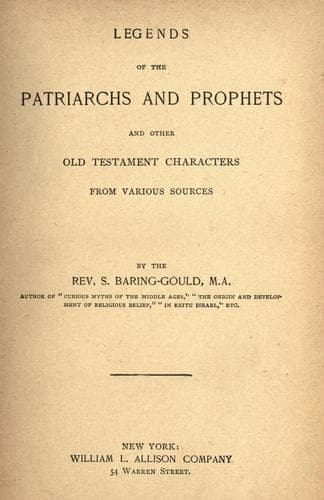
Legends of the Patriarchs and Prophets: And Other Old Testament Characters from Various SourcesBaring-Gould, S. (Sabine)
Religion
Legends of the Patriarchs and Prophets: And Other Old Testament Characters from Various Sources
Baring-Gould, S. (Sabine)
Bible. Old Testament -- Legends
Of all the spoil which Abraham had taken, he separated a tenth part,
and he gave it to Melchizedek, as the offering due to the priest, and
this was the first tithe paid in the history of the world. All the
booty of Sodom Abraham returned to the king thereof, and he took an
oath, “_I will not take from a thread even to a shoe-latchet, and I
will not take any thing that is thine, lest thou should say, I have
made Abraham rich, save only that which the young men have eaten, and
the portion of the men which went with me, Aner, Eshcol, and Mamre; let
them take their portion._”[309]
On account of this unselfishness, the remembrance of which was to be
continued through all generations, God gave the descendants of Abraham
maxims to be written on their phylacteries and shoe-latchets; and the
promise was made, “_Over Edom will I cast out my shoe_;”[310] that is,
Edom, the most cruel oppressor of the chosen people, should fall under
the condemnation of the Most High.
The end of Nimrod and his confederate kings is related with greater
fulness by the Mussulman historians.
According to Tabari, God sent an army of flies against the host of
Chedorlaomer and Nimrod, and these flies attacked the soldiers in their
faces; and the flies were so numerous that the soldiers could not
see one another; and the horses stung by them went mad, and leaped,
and fell; so that, what with the horses and the flies, the army was
entirely dispersed. Nimrod escaped to Babylon, but he was pursued by
the meanest of the gnats of that host; it was blind of one eye and lame
of one leg. When Nimrod sat down on his throne, the gnat settled upon
his knee. Then the tyrant smote at it; and it rose, flew up one of his
nostrils and entered his brain, which it began to devour.
Nimrod beat his face and his head, and when he did so the fly ceased
gnawing at his brain, but he had no repose from his agonies save when
struck upon the head. Consequently there was, after that, always
some one stationed by him to strike his head. The king had a large
blacksmith’s hammer brought into his throne-room, and with that his
princes and nobles smote him on the head; and the more violent the
blow, the greater was the relief afforded. Nimrod reigned a thousand
years before he felt the torment of the gnat; up to that moment he had
suffered no pains. He lived for five hundred years with the fly eating
at his brain; and all that while, night and day, there were relays of
men to strike his head with the hammer.[311]
Precisely the same story is told by the Jewish Rabbis of Titus.[312]
There is, however, another version of the tradition; which is, that
the gnat fattening on the brain grew in size till it swelled to the
dimensions of a pigeon, and then the skull of Nimrod burst, and the
gnat flew away; and this was fifteen days after it had entered by his
nose.[313]
More shall be told of Melchizedek in a separate article.
4. THE BIRTH OF ISHMAEL.
Public-domain text, read in full here on John Shaqi.
Reviews
Reviews
No reviews yet
Be the first to share your thoughts on this work.
Elsewhere in the archive
Join the Discussion
Join the discussion
Sign in to leave a comment or review.
Sign InorCreate an account