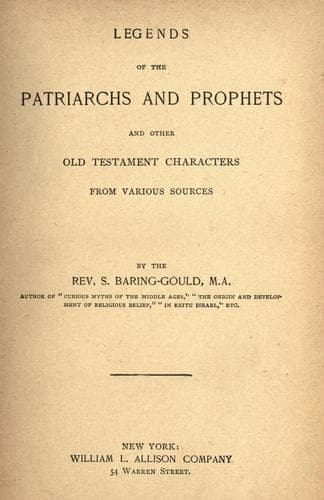
Legends of the Patriarchs and Prophets: And Other Old Testament Characters from Various SourcesBaring-Gould, S. (Sabine)
Religion
Legends of the Patriarchs and Prophets: And Other Old Testament Characters from Various Sources
Baring-Gould, S. (Sabine)
Bible. Old Testament -- Legends
After the engagement had been drawn up, as it is written in the first
book of Moses,[341] Eliezer urged for a speedy departure. Mother and
brother consented, but on the following day they asked that, besides
the seven days of mourning for Bethuel, they should tarry a year, or at
least ten months, according to the usual custom. But Rebekah opposed
them, and said that she would go at once.
It was noon when Eliezer and his retinue, together with Rebekah and her
nurse Deborah, left Haran, and in three hours they were at Hebron.
At the self-same time Isaac was abroad in the fields, returning from
the school of Seth, lamenting over his mother, and saying his evening
prayer. Rebekah saw him with his hands outspread, and his angel walking
behind him, and she said, “Who is that with a shining countenance, with
another walking behind him?”
At the same moment she knew who it was, and with prophetic vision she
saw that she would become the mother of Esau, and she trembled and fell
from the camel.
Isaac took Rebekah to wife and led her into the tent of Sarah, and the
door was once more open, and the perpetual lamp was again kindled, and
it seemed to Isaac as if all the happiness that had gone with Sarah,
had returned with Rebekah, so he was comforted for his mother.
Eliezer was rewarded for his faithful service, for Abraham gave him his
freedom, and he was taken into Paradise without having tasted of death.
13. THE DEATH OF ABRAHAM.
Abraham, after the death of Sarah, had brought back Hagar, and she
was called Keturah, which signifies “the Bond-woman,” and this she
was called because she had ever regarded herself as bound to Abraham,
though he had cast her away. But others say that Keturah was not
Hagar, but was a daughter of one of Abraham’s slaves. She bare him six
sons,[342] all strong, and men of clear understandings.
According to Mussulman traditions, she was the daughter of Jokdan, and
was a Canaanitish woman.
Abraham said to the Most High, in gratitude of heart, “Thou didst
promise me one son, Isaac, and thou hast given me many!”
All his substance he gave to Isaac; but some say he gave him a double
portion only, and the rest he made over to his other sons. And to Isaac
only he gave the right to be buried in the cave of Machpelah, and
along with that, his blessing. But others say that he did not give his
blessing to Isaac, lest it should cause jealousy to spring up between
him and his brothers. He said, “I am a mortal man; to-day here and
to-morrow in the grave; I have done all I can do for my children, and
now I will depart when it pleases my heavenly Father.”
He sent the sons of Keturah away, that they might not dwell near Isaac,
lest his greatness should swallow them up; and he built them a city of
iron, with walls of iron. But the walls were so high that the light
of the sun could not penetrate the streets, therefore he set in them
diamonds and pearls to illumine the iron city.
Public-domain text, read in full here on John Shaqi.
Reviews
Reviews
No reviews yet
Be the first to share your thoughts on this work.
Elsewhere in the archive
Join the Discussion
Join the discussion
Sign in to leave a comment or review.
Sign InorCreate an account