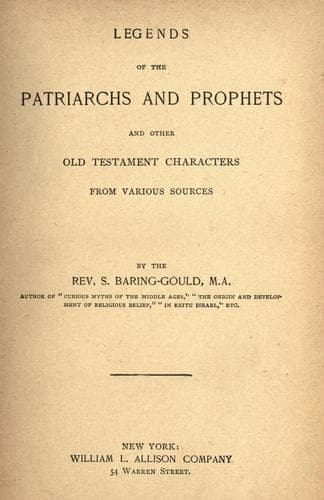
Legends of the Patriarchs and Prophets: And Other Old Testament Characters from Various SourcesBaring-Gould, S. (Sabine)
Religion
Legends of the Patriarchs and Prophets: And Other Old Testament Characters from Various Sources
Baring-Gould, S. (Sabine)
Bible. Old Testament -- Legends
Alexander was called the Two-horned, according to some, because he went
through the world from one end to the other; according to others,
because he wore two long locks of hair which stood up like horns;
according to others, because he had two gold horns on his crown which
symbolized the kingdoms of Grecia and Persia over which he reigned. But
according to others, he once dreamed that he had got so near to the
son, that he caught it by its two ends, and therefore he was given his
name.
Learned men are also equally disagreed as to the time in which he
lived, and as to the place of his birth and residence.
Most think that there were two Alexanders. One was descended from Shem,
and went with El Khoudr to the end of the world after the Fountain of
Immortality, and who was ordered by God to build an indestructible wall
against the incursions of the children of Gog and Magog. The other
Alexander was the son of Philip of Macedon, and was descended from
Japheth, and was the pupil of Aristotle at Athens.[358]
And now let us return to the fountain or well of Zemzem, and relate
what befel that.
Nabajoth, the eldest son of Ishmael, succeeded his father in the
custody of the Kaaba, of the tombs of Adam and Eve, of the stone and
the well. But having left only very young children to succeed him,
Madad-ben-Amron, their maternal grandfather, took charge of their
education, and at the same time became the protector of the Kaaba and
of the well of Zemzem.
The children of Nabajoth, when they grew old, would not contest with
their foster-father the possession of the Holy places, therefore it
remained to him and his sons till the time when the Giorhamides took
them by violence.
Then the posterity of Ishmael having attacked them, defeated them, and
recovered the city and temple of Mecca. But the stone, and the two
gazelles of gold which a king of Arabia had given to the Kaaba, had
been lost, for they had been thrown into the well of Zemzem, which had
been filled up.
The well remained choked and unregarded till the times of
Abd-el-Motalleb, grandfather of Mohammed, who one day heard a voice bid
him dig the well of Zemzem.
Abd-el-Motalleb asked the voice what Zemzem was.
Then the voice replied: “It is the well that sprang up to nourish
Ishmael in the desert, whereof he and his children drank.”
Abd-el-Motalleb, not knowing whereabouts to dig, asked further, and
the voice answered, “The well of Zemzem is near two idols of the
Koraïschites named Assaf and Nailah; dig on the spot where you shall
see a magpie pecking in the ground and turning up a nest of ants.”
Abd-el-Motalleb set about obeying the voice, in spite of the opposition
of the Koraïschites, who objected to the overthrow of their idols.
However, he dug, along with his ten sons, and he vowed that if God
would show him the water, he would sacrifice one of his sons. And when
he came to water, he found the gazelles of gold and the Black Stone.
Public-domain text, read in full here on John Shaqi.
Reviews
Reviews
No reviews yet
Be the first to share your thoughts on this work.
Elsewhere in the archive
Join the Discussion
Join the discussion
Sign in to leave a comment or review.
Sign InorCreate an account