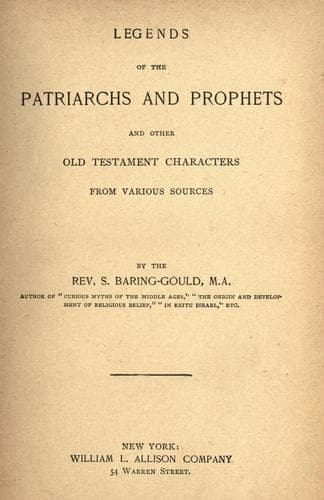
Legends of the Patriarchs and Prophets: And Other Old Testament Characters from Various SourcesBaring-Gould, S. (Sabine)
Religion
Legends of the Patriarchs and Prophets: And Other Old Testament Characters from Various Sources
Baring-Gould, S. (Sabine)
Bible. Old Testament -- Legends
Therefore Jacob went out only at night; during the day he hid himself
away. Thus several years passed, and his life became intolerable to
him. So his mother said, “Thy uncle Laban, the son of Bethuel, has
great possessions, and is very old. Go, and ask him to give thee his
daughter; and if he consents, then tarry with him till thy brother’s
anger turn away.” Jacob listened to the advice of his mother, and he
fled away without letting Esau know.
Five miracles were wrought for the patriarch Jacob, at the time
when he went forth from Beer-sheba. First, the hours of the day were
shortened, and the sun went down before its time, because the Word
desired to speak with him; secondly, the four stones, which Jacob had
set for his pillow, he found in the morning had coagulated into one
stone; thirdly, the stone which, when all the flocks were assembled,
the shepherds rolled from the mouth of the well, he rolled away with
one of his arms; fourthly, the well overflowed, and the water continued
to flow all the days he was in Haran. The fifth sign--the country was
shortened before him, so that in one day he went forth and came to
Haran.[380]
And he prayed in the place where he rested, and took four stones of
that place, and set them for a pillow, and went asleep. Of these stones
this is the history. They were twelve in number, and Adam had set them
up as an altar. On them Abel had offered his sacrifice. The Deluge had
thrown them down, but Noah reared them once more. They had been again
overthrown, but Abraham set them in their places, and of them built the
altar on which to sacrifice Isaac. These twelve stones Jacob now found,
and he placed them under his head as a pillow. But a great wonder was
wrought, and in the morning the twelve stones had melted together into
one stone.[381]
Finally, this stone, so ancient and with such a history, was carried
to Scotland, by whom I do not know, where it was placed at Scone, and
was used for the consecration of the Scottish kings. Edward I. of
England brought it to London, and it was set beneath the chair of the
Confessor, as the following lines, inscribed on a tablet, announced:--
“Si quid habent veri, vel chronica cana, fidesve,
Clauditur hac cathedra nobilis, ecce, lapis.
Ad caput eximius Jacob quondam patriarcha
Quem posuit cernens numina mira poli.
Quem tulit ex Scottis, spolians quasi victor honoris,
Edwardus primus, Mars velut omnipotens.
Scottorum domitor, noster validissimus Hector,
Anglorum decus, et gloria militiæ.”[382]
The stone may now be seen in Westminster Abbey.
Public-domain text, read in full here on John Shaqi.
Reviews
Reviews
No reviews yet
Be the first to share your thoughts on this work.
Elsewhere in the archive
Join the Discussion
Join the discussion
Sign in to leave a comment or review.
Sign InorCreate an account