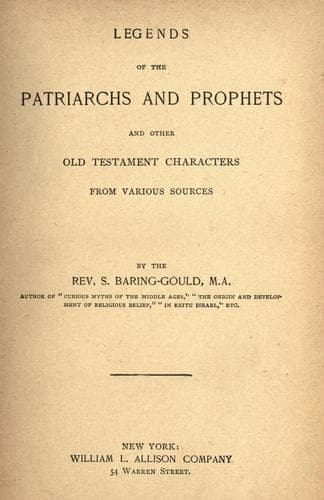
Legends of the Patriarchs and Prophets: And Other Old Testament Characters from Various SourcesBaring-Gould, S. (Sabine)
Religion
Legends of the Patriarchs and Prophets: And Other Old Testament Characters from Various Sources
Baring-Gould, S. (Sabine)
Bible. Old Testament -- Legends
Jacob, says the Rabbi Samuel, could recite the whole of the
Psalter.[393] Of course this must have been in the spirit of prophecy,
as the Psalms were not written, with the exception of Psalm civ., which
had been composed by Adam.
Adam, after his fall, had been given by God six commandments, but
Noah was given a seventh--to this effect, that he was not to eat a
limb or portion of any living animal. Abraham was given an eighth,
the commandment of circumcision; and Jacob was communicated a ninth,
through the mouth of an adder, that he was not to eat the serpent.[394]
If we may trust the Book of Jasher, the affair of Shechem, the son of
Hamor, was as follows:--The men of the city were not all circumcised,
only some of them, so as to blind the eyes of the sons of Jacob,
and throw them off their guard; and Shechem and Hamor had privately
concerted to fall upon Jacob and his sons and butcher them; but Simeon
and Levi were warned of their intention by a servant of Dinah, and took
the initiative.[395] But this is a clumsy attempt to throw the blame
off the shoulders of the ancestors of the Jewish nation upon those of
their Gentile enemies.
Jacob, say the Rabbis, would have had no daughters at all in his
family, but only sons, had he not called himself El-elohe-Israel
(Israel is God).[396] Therefore God was angry with him, for making
himself equal with God, and in punishment he afflicted him with a giddy
daughter.[397]
Esau, say the Mussulmans, had no prophets in his family except Job.
All the prophets rose from the family of Jacob; and when Esau saw that
the gift of prophecy was not in his family, he went out of the land,
for he would not live near his brother.[398]
The father of the Israelites, from the land of Canaan which he
inhabited, could smell the clothes of Joseph when he was in Egypt,
being a prophet; and thus he knew that his son was alive. He was
asked how it was that he divined nothing when his beloved son was
cast into the pit by his brothers, and sold to the Ishmaelites. He
replied that the prophetic power is sudden, like a lightning flash,
piercing sometimes to the height of heaven; it is not permanent in its
intensity, but leaves at times those favored with it in such darkness
that they do not know what is at their feet.[399]
The Arabs say that Jacob, much afflicted with sciatica, was healed by
abstaining from the meat he most loved, and that was the flesh of the
camel. At Jerusalem, say the Arabs, is preserved the stone on which
Jacob laid his head when he slept on his way to Haran.
The custom of saying “God bless you!” when a person sneezes, dates
from Jacob. The Rabbis say that, before the time that Jacob lived,
men sneezed once, and that was the end of them--the shock slew them;
but the patriarch, by his intercession, obtained a relaxation of this
law, subject to the condition that, in all nations, a sneeze should be
consecrated by a sacred aspiration.
XXVIII.
JOSEPH.
Public-domain text, read in full here on John Shaqi.
Reviews
Reviews
No reviews yet
Be the first to share your thoughts on this work.
Elsewhere in the archive
Join the Discussion
Join the discussion
Sign in to leave a comment or review.
Sign InorCreate an account