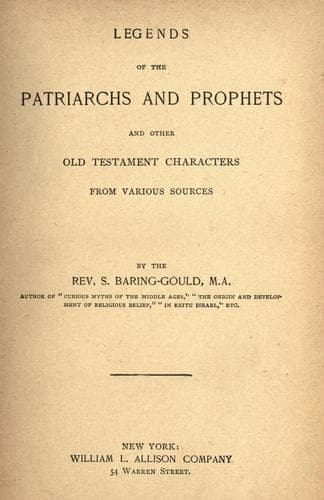
Legends of the Patriarchs and Prophets: And Other Old Testament Characters from Various SourcesBaring-Gould, S. (Sabine)
Religion
Legends of the Patriarchs and Prophets: And Other Old Testament Characters from Various Sources
Baring-Gould, S. (Sabine)
Bible. Old Testament -- Legends
On the third morning, a party of Arabs passed near the well, and were
thirsty. Now the chief of these Arabs was Melek-ben-Dohar; the second,
who accompanied Melek, was an Indian, a freed man of Melek, and his
name was Buschra.
Melek reached the well carrying a bucket and a rope, and let down the
bucket into the well. Then Joseph put his hand on it, and, however much
Melek and Buschra pulled, they could not raise the bucket. Then Melek
looked down into the pit, and exclaimed: “O Buschra, the bucket was
heavy because a young man has hold of it.”
Now the face of Joseph illumined the well like a lamp: Buschra and
Melek tried to raise Joseph, but they could not.
Then Melek asked, “What is thy name, and whence art thou?”
Joseph answered, “I am a young man of Canaan; my brothers have cast me
into this cistern, but I am not guilty.”
Melek said to his companions, “If we tell the rest of the caravan that
we have drawn this youth out of the well, they will demand a share in
the price he will fetch. Now I can sell this youth for a large sum in
Egypt. I will therefore tell my comrades that I have bought him from
some people who were at the well. Do thou say the same thing, and we
will share the money between us.”
Next day, being the fourth day, the brethren, finding that their
father’s face was turned against them, went to the cistern to draw
forth Joseph, and when they found him not, they went to the caravan,
and they saw Joseph among the Arabs.
Then they asked, “Whose is this lad?”
Melek-ben-Dohar replied, “He his mine.”
They answered, “He belongs to us; he ran away from us.”
Melek replied, “Well, I will give you money for him.”[409]
So he bought him for twenty pieces of silver; thus each of the brothers
obtained two drachmæ, and therewith they bought shoes.[410] To this
the prophet Amos refers in two places (ii. 6; viii. 6), and in the
Testament of the Twelve Patriarchs, which is received as canonical by
the Armenian Church, Zebulun relates the same circumstance, that the
brethren supplied themselves with sandals from the money which they got
by the sale of Joseph.
Joseph went along with the Ishmaelites till they passed his mother’s
tomb; then his grief overcame him, and he burst forth into bitter tears
and cried, “O mother, mother! I am an outcast and a slave, I the child
of the wife Jacob loved. When thou wast dying, thou didst show me to
my father, and bade him look on me, and be comforted for my loss. O
mother, mother! hast thou no thought of thy son? Awake and see the
miserable condition of thy child; shake off thy sleep; be my defence
against my brethren, and comfort my father. Awake and stand up to judge
my quarrel, awake and plead my cause with God! awake and look upon the
desolation of the soul of my father who cherished thee, and who for
fourteen years served a hard bondage for his beloved Rachel! Console
him, I pray thee, and by the voice that he loves, soothe the grief of
his last days.”
Public-domain text, read in full here on John Shaqi.
Reviews
Reviews
No reviews yet
Be the first to share your thoughts on this work.
Elsewhere in the archive
Join the Discussion
Join the discussion
Sign in to leave a comment or review.
Sign InorCreate an account