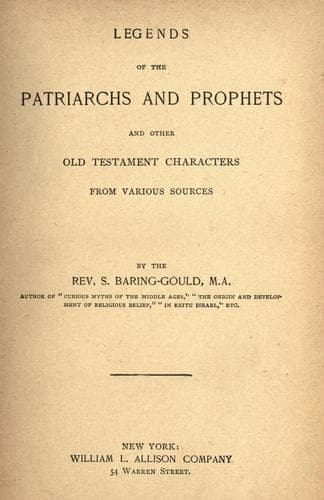
Legends of the Patriarchs and Prophets: And Other Old Testament Characters from Various SourcesBaring-Gould, S. (Sabine)
Religion
Legends of the Patriarchs and Prophets: And Other Old Testament Characters from Various Sources
Baring-Gould, S. (Sabine)
Bible. Old Testament -- Legends
Then all the worms that were in the inside of Job died, and he was
quite whole. Now this took place in Bashan, and the fountain remains
to this day, and is called Qarya-Aïyub, and the city near which it is,
Aïrs-Aïyub. “I have seen the city of the fountain,” says the Persian
translator of Tabari: “every person who goes there, affected by
internal or external maladies, and washes and drinks of that water, is
healed of his disease.”[450]
Then God said to Job, “Fulfil thy vow, and take in thine hand a bundle
of rods.”[451] But the rods God told him to take were light sticks;
and he took a hundred of these, and bound them together and smote
Rahma with them, and he did not hurt her. By this action of Job, the
Mussulman doctors support their advice to those who have taken rash
oaths to clear themselves by a subterfuge. Thus, if a man has sworn
he will not enter his house again, he is recommended to allow himself
to be bound hand and foot and be carried into his home. Or, if he has
sworn to recite the whole Koran, it will be sufficient for him to say
the word “Koran,” and listen to the imaum reading before the assembly.
Then God restored to Job double all that he had lost; and Job lived,
after he was recovered of his disease, twenty years, and he died at the
age of ninety-three.
The worms which had devoured the body of the prophet, God turned into
silk-worms; and the flies which had bitten him and tormented his sores,
converted He into honey-bees; and before this there were neither
silk-worms nor honey-bees on the earth. Also the rain and the snow
which fell within his possessions, were grains of gold and pearl.
Isidore of Seville places the fountain which cured Job in Idumæa. He
says, it is clear during three months of the year, troubled during the
next three, then for three months it is green, and for the last three,
it is red.
In the “Testament of Job,” we read some details concerning his death,
written by his brother Nahor.
After three days of sickness, Job, lying on his bed, saw the angels
come to receive his soul. After having divided his substance between
his seven sons (for, after his troubles, he became the father of seven
sons and three daughters), he gave his daughters three mantles of
inestimable price, which he had received from heaven. To the eldest,
Hemera (Jemima), he gave his harp; to the second, Cassia (Keziah),
he handed his censer; to the third, Keren-happuch, he remitted his
tamborine: and as he sang his last hymn to the Most High on his
death-bed, Hemera and Keren-happuch accompanied him with harp and
timbrel, and Cassia cast up fumes of sweet incense. Thus they greeted
the messengers of heaven who came for the soul of Job.
XXXI.
JETHRO.
Public-domain text, read in full here on John Shaqi.
Reviews
Reviews
No reviews yet
Be the first to share your thoughts on this work.
Elsewhere in the archive
Join the Discussion
Join the discussion
Sign in to leave a comment or review.
Sign InorCreate an account