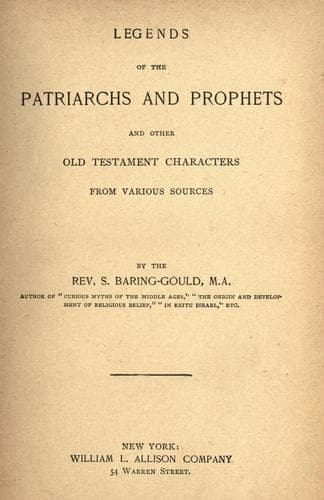
Legends of the Patriarchs and Prophets: And Other Old Testament Characters from Various SourcesBaring-Gould, S. (Sabine)
Religion
Legends of the Patriarchs and Prophets: And Other Old Testament Characters from Various Sources
Baring-Gould, S. (Sabine)
Bible. Old Testament -- Legends
For he had, for long, been slowly turning against Moses, when he saw
that he walked not in the ways of the Egyptians, and that he loved
the king’s enemies, and hated the king’s friends. Then he consulted
his soothsayers and his councillors, and they gave him advice that
he should put Moses to death with the sword. Therefore the young
man, Moses, was brought forth, and he ascended the scaffold, and the
executioner stood over him with his sword, the like of which was not in
the whole world. And when the king gave the word, the headsman smote.
But the Lord turned the neck of Moses into marble, and the sword bit
not into it.
Instantly, before the second blow was dealt, the angel Michael took
from the executioner his sword and his outward semblance, and gave to
the headsman the semblance of Moses, and he smote at the executioner,
and took his head from off his shoulders. But Moses fled away, and none
observed him. And he went to the king of Ethiopia.[479]
Now the king of Ethiopia, Kikannos (Candacus) by name, was warring
against his enemies; and when he left his capital city, Mero, at the
head of a mighty army, he left Balaam and his two sons regents during
his absence.
Whilst the king was engaged in war, Balaam and his sons conspired
against the king, and they bewitched the people with their
enchantments, and led them from their allegiance, and persuaded them
to submit to Balaam as their king. And Balaam strengthened the city on
all sides. Sheba, or Mero, was almost impregnable, as it was surrounded
by the Nile and the Astopus. On two sides Balaam built walls, and on
the third side, between the Nile and the city, he dug countless canals,
into which he let the water run. And on the fourth side he assembled
innumerable serpents. Thus he made the city wholly impregnable.
When King Kikannos returned from the war, he saw that his capital was
fortified, and he wondered; but when he was refused admission, he knew
that there was treason.
One day he endeavored to surmount the walls, but was repulsed with
great slaughter; and the next day he threw thirty pontoons across the
river, but when his soldiers reached the other side, they were engulfed
in the canals, of which the water was impelled with foaming fury by
great mill-wheels. On the third day he assaulted the town on the fourth
side, but his men were bitten by the serpents and died. Then King
Kikannos saw that the only hope of reducing the city was by famine; so
he invested it, that no provisions might be brought into it.
Whilst he sat down before the capital, Moses took refuge in his camp,
and was treated by him with great honor and distinction.
As the siege protracted itself through nine years, Kikannos fell ill
and died.
Public-domain text, read in full here on John Shaqi.
Reviews
Reviews
No reviews yet
Be the first to share your thoughts on this work.
Elsewhere in the archive
Join the Discussion
Join the discussion
Sign in to leave a comment or review.
Sign InorCreate an account