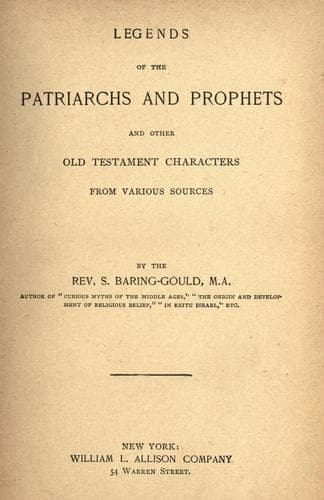
Legends of the Patriarchs and Prophets: And Other Old Testament Characters from Various SourcesBaring-Gould, S. (Sabine)
Religion
Legends of the Patriarchs and Prophets: And Other Old Testament Characters from Various Sources
Baring-Gould, S. (Sabine)
Bible. Old Testament -- Legends
But Solomon stood up, and said, “Not so; let the husbandman have the
wool, and the milk of the flock, till the wheat is grown up again as it
was before the sheep destroyed it.”
And all wondered at his wisdom.
But the king’s elders and councillors were filled with envy, because
this child’s opinion was preferred before theirs; and they complained
to King David.
Then David said, “Call an assembly of the people, and prove Solomon
before them, whether he be learned in the Law, and whether he have
understanding and wit.”
So the people were assembled, and the elders took council together how
they might perplex him with hard questions. But or ever they asked him,
he answered what they had devised, and they were greatly confounded,
so that the people supposed this was a preconcerted scene arranged
by the king. Then, when the elders were silenced, Solomon turned to
their chief, and said, “I too will prove you with questions. What you
have asked me have been trials of my learning, but what I will ask you
shall put to proof the readiness of your wits. What is all, and what is
nothing? What is something, and what is naught?”
The elder was silent; he thought, but he knew not what was the answer.
And all the people perplexed themselves to discover the riddle, but
they could not. Then said Solomon, “God is all, and the world He made
is as nothing before Him. The faithful is something, but the hypocrite
is naught.”
Thereupon he turned to a second, and he said: “What are most and what
are fewest? What is the sweetest, and what is the bitterest?” But
when the second could find no solution to these questions, Solomon
answered, “Most men are unbelievers, the fewest have true faith. The
sweetest thing is the possession of a virtuous wife, good children,
and a competence; the bitterest thing is to have a disreputable wife,
disorderly children, and penury.”
Then Solomon turned to a third elder and asked: “What is the most
odious sight, and what is the most beautiful sight? What is the surest
thing, and what is that which is most insecure?”
And when this elder also was unable to give an answer, Solomon
interpreted his riddle once more, “The most odious sight is to see a
righteous man fall away; the most beautiful sight is to see a sinner
repent. The surest thing is death, the most insecure thing is life.”
After that Solomon said to all the people, “Ye see that the oldest
and the most learned men are not always the wisest. True wisdom comes
not with years, nor is derived from books, but is a gift of God the
All-wise.”
Solomon by his words threw the whole assembly into astonishment, and
all the heads of the people cried with one voice, “Praised be the Lord,
who has given to our king a son who surpasses all in wisdom, and who is
worthy to ascend the throne of his father David.”
Public-domain text, read in full here on John Shaqi.
Reviews
Reviews
No reviews yet
Be the first to share your thoughts on this work.
Elsewhere in the archive
Join the Discussion
Join the discussion
Sign in to leave a comment or review.
Sign InorCreate an account