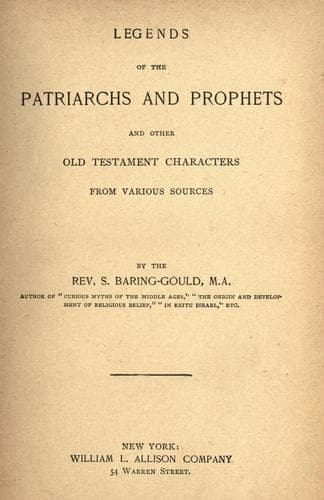
Legends of the Patriarchs and Prophets: And Other Old Testament Characters from Various SourcesBaring-Gould, S. (Sabine)
Religion
Legends of the Patriarchs and Prophets: And Other Old Testament Characters from Various Sources
Baring-Gould, S. (Sabine)
Bible. Old Testament -- Legends
But Palestine seems also to have possessed some of the trees of Adam’s
planting, for Jacob Vitriacus in his Jewish History says: “There are in
that land wonderful trees, which for their pre-excellence are called
Apples of Paradise, bearing oblong fruit, very sweet and unctuous,
having a most delicious savor, bearing in one cluster more than a
hundred compressed berries. The leaves of this tree are a cubit long
and half a cubit wide. There are three other trees producing beautiful
apples or citrons, in which the bite of a man’s teeth is naturally
manifest, wherefore they are called Adam’s Apples.”[100] Hottinger says
that at Tripoli grows a tree called Almaus, or Adam’s apple, with a
green head, and leaves like outspread fingers, no branches, but only
leaves, and with a fruit like a bean-pod, of delicious flavor, and an
odor of roses. Buntingius, in his Itinerary, describes an Adam’s apple
which he tasted at Alexandria, and he said the taste was like pears,
and the clusters of prodigious size, with twenty in each cluster, like
magnificent bunches of grapes. But the most remarkable fact about
them was that, if one of the fruit were cut with a knife, the figure
of a crucifix was found to be contained in it.[101] And this tree
was supposed to have been the forbidden tree, and the fruit to have
thus brought hope as it also brought death to the eater. Nider, “In
Formicario,” also relates that this fruit, thus marked with the form of
the Crucified, grows in Granada.[102]
“At Beyrut, of which S. Nicodemus was the first bishop,” writes the
Friar, Ignatius von Rheinfelden, “I saw a wonderful fruit which is
called by the Arabs, Mauza, and by the Christians Adam’s fig. This
fruit grows upon a trunk in clusters of fifty or more, and hangs down
towards the ground on account of its weight. The fruit is in shape
something like a cucumber, and is a span long, yellow, and tasting
something like figs. The Christians of those parts say it is the fruit
of which Adam and Eve ate in Paradise, and they argue thus: first,
there are no apples in those parts; secondly, S. Jerome translated
the word in the Bible, Mauza; thirdly, if the fruit be cut, within it
is seen the figure of a crucifix, and they conclude thereby that the
first parents were showed by this figure how their sin would be atoned;
fourthly, the leaves being three ells long and half an ell wide, were
admirably adapted to make skirts of, when Adam and Eve were conscious
of their nakedness. And Holy Scripture says nothing of apples, but says
merely--fruit. But whether this was the fruit or not, I leave others to
decide.”[103]
Public-domain text, read in full here on John Shaqi.
Reviews
Reviews
No reviews yet
Be the first to share your thoughts on this work.
Join the Discussion
Join the discussion
Sign in to leave a comment or review.
Sign InorCreate an account