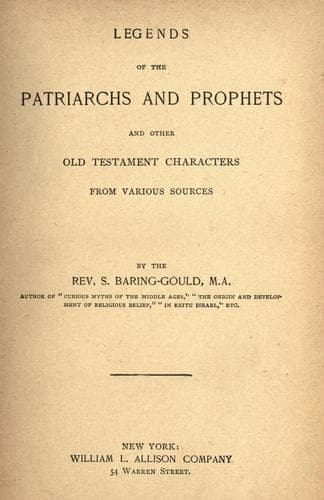
Legends of the Patriarchs and Prophets: And Other Old Testament Characters from Various SourcesBaring-Gould, S. (Sabine)
Religion
Legends of the Patriarchs and Prophets: And Other Old Testament Characters from Various Sources
Baring-Gould, S. (Sabine)
Bible. Old Testament -- Legends
Enoch replied, “Be it so;” and he went in and viewed Paradise, and came
out, as he had promised; and as he passed the threshold of the door he
turned and said to the angel, “Oh, Ridhwan! I have left something in
there; suffer me to run and fetch it.”
But Ridhwan refused; and a dispute arose between them.
Enoch said, “I am a prophet; and God has sent me thirty books, and I
have written them all, and I have never revolted against God. In those
books that God sent me, I was promised Paradise. If it be necessary
that I should have undergone death I have undergone it. If it be
necessary that I should have seen Hell, I have seen it. Now I am come
to Paradise, and that is my home; God has promised it to me, and now
that I have entered I will leave it no more.”
The dispute waxed hot, but it was terminated by the order of God, who
bade Ridhwan open the gate and re-admit Enoch into Paradise, where he
still dwells.[155]
2. THE BOOK OF ENOCH.
The Book of Enoch, quoted by S. Jude in his Epistle, and alluded to
by Origen, S. Augustine, S. Clement of Alexandria, and others of the
Fathers, must not be passed over.
The original book appears from internal evidence to have been written
about the year 110 B. C.[156] But we have not the work as then written;
it has suffered from numerous interpolations, and it is difficult
always to distinguish the original text from the additions.
The book is frequently quoted in the apocryphal “Testament of the
Twelve Patriarchs,” which is regarded as canonical by the Armenian
Church, but the references are for the most part not to be found in
the text. It was largely used by some of the early Christian writers,
either with acknowledgment or without. The monk George Syncellus, in
the eighth century, extracted portions to compose his Chronography.
This fragment in Syncellus was all that was known of the book in the
West till the last century. The Jews, though remembering the work, had
lost it in Hebrew; but it was alluded to by the Rabbis down to the
thirteenth century, and it is referred to in the Book Sohar, though
the writer may not have read the book of Enoch. Bruce, the African
traveller, was the first to bring it to Europe from Abyssinia in two
MSS., in the year 1773. Much attention was not, however, paid to it
till 1800, when De Sacy in his “Magasin Encyclopédique,” under the
title “Notice sur le Livre d’Enoch,” gave some account of the work. In
1801, Professor Laurence gave to the public an English translation,
accompanied by some critical remarks. Since then, the book has been
carefully and exegetically examined. The version we now have is
Ethiopic.
The Book of Enoch consists of five divisions, or books, together with a
Prolegomena and an Epilegomena.
Public-domain text, read in full here on John Shaqi.
Reviews
Reviews
No reviews yet
Be the first to share your thoughts on this work.
Elsewhere in the archive
Join the Discussion
Join the discussion
Sign in to leave a comment or review.
Sign InorCreate an account