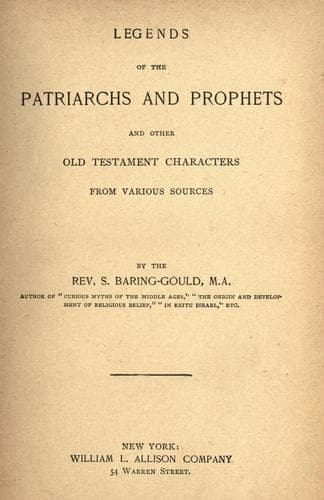
Legends of the Patriarchs and Prophets: And Other Old Testament Characters from Various SourcesBaring-Gould, S. (Sabine)
Religion
Legends of the Patriarchs and Prophets: And Other Old Testament Characters from Various Sources
Baring-Gould, S. (Sabine)
Bible. Old Testament -- Legends
Among the Oriental Christians it is said, that Adam having related to
the children of Seth the delights of Paradise, several of them desired
to recover the lost possession. They retired to Mount Hermon and dwelt
there in the fear of the Lord; living in great austerity, in hope that
their penitence would recover Eden. But the Canaanites dwelt round them
on all sides, and the sons of Seth becoming tired of celibacy, took
the daughters of the Canaanites to wife, and to them were born the
giants.[165]
Others say that the posterity of the patriarch Seth were those called
the “Sons of God,” because they lived on Mount Hermon in familiar
discourse with the angels. On this mountain they fed only on the fruit
of the earth, and their sole oath was “By the blood of Abel.”[166]
Among the giants was Surkrag, of whom we have already related a few
particulars. He was not of the race of men, nor of the posterity of
Adam. According to the Mussulman account he was commander of the armies
of Soliman Tchaghi, who reigned over the earth before the time of Gian
ben Gian, who succeeded him and reigned seven thousand years. The whole
earth was then in the power of the Jins. Gian ben Gian erected the
pyramids of Egypt.
Surkrag obeyed God, and followed the true religion, and would not
suffer his subject Jins to insult or maltreat the descendants of Adam.
He reigned on Mount Kaf, and allied himself, according to Persian
authorities, with Kaïumarth, the first king of the world, whom some
Persian writers identify with Adam, but others suppose to be the son
of Mahalaleel, and cotemporary with Enoch. Ferdusi, the author of the
Schah-Nâmeh, speaks of him as the first who wore a crown and sat on
a throne, and imposed a tribute on his subjects. He says that this
monarch lived a thousand years, and reigned five hundred and fifty
years. He was the first to teach men to build houses.
But if Kaïumarth was the first man to reign, he was the first also to
weary of it; for he abdicated his sovereignty and retired into his
former abode, a cave, after having surrendered his authority to his son
Siamek. Siamek having been killed, Kaïumarth re-ascended his throne
to revenge his death. After having recovered the body of his son, he
buried him with great honors, and kindled over his grave a great fire,
which was kept perpetually burning, and this originated the worship of
fire among the people of Iran.
Public-domain text, read in full here on John Shaqi.
Reviews
Reviews
No reviews yet
Be the first to share your thoughts on this work.
Elsewhere in the archive
Join the Discussion
Join the discussion
Sign in to leave a comment or review.
Sign InorCreate an account