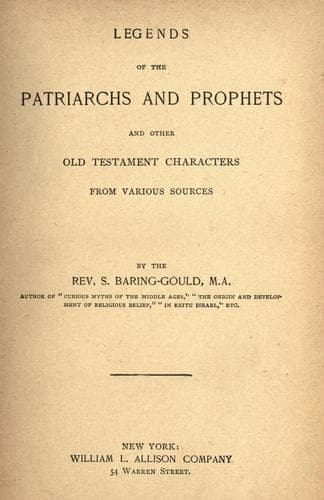
Legends of the Patriarchs and Prophets: And Other Old Testament Characters from Various SourcesBaring-Gould, S. (Sabine)
Religion
Legends of the Patriarchs and Prophets: And Other Old Testament Characters from Various Sources
Baring-Gould, S. (Sabine)
Bible. Old Testament -- Legends
Ararat has borne this name for three thousand years. We read in the
Book of Genesis that “_the ark rested, in the seventh month, on the
seventeenth day of the month, upon the mountains of Ararat_.” In
passages of the Old Testament, as in Isaiah xxxvii. 38 and 2 Kings
xix. 37, mention is made of a land, in Jeremiah li. 27 of a kingdom,
of Ararat; and we are likewise informed by Moses of Chorene, the first
authority among Armenian writers, that an entire country bore this name
after an ancient Armenian king, Arai the Fair, who lived about 1750
years before Christ. He fell in a bloody battle with the Babylonians on
a plain in Armenia, called after him Arai-Arat, the Fall of Arai.
Before this event the country bore the name of Amasia, from its
sovereign, Amassis, the sixth in descent from Japheth, who gave the
name of Massis to the mountain. This is still the only name by which
it is known to the Armenians; for, though it is called Ararat in the
Armenian edition of the Old Testament, yet the people call it Massis,
and know no other name for it. The Mussulmans call it Agridagh, the
strong mountain. The name by which it is known to the Persians is
Kuhi-Nuh, the mountain of Noah, or Saad-dagh, the Blessed Mountain.[205]
But tradition is not at one as to the peak on which the ark rested,
or from which Noah descended, as we shall presently see. Ararat is
17,210 feet in altitude above the sea, and 14,320 feet above the plain
of the Araxes. On the northeastern slope of the mountain, even from a
distance, may be seen a deep, gloomy chasm, which gives the appearance
as if the mountain had been rent asunder at the top: this was probably
at some remote period the volcanic vent, for the mountain is composed
of tufa, scoria, and erupted matter. It shoots up in one rigid crest,
and then sweeps down towards Little Ararat, the second summit, which
stands 13,000 feet above the sea.[206]
The people of the neighborhood point to a step on the mountain side,
covered with perpetual snow and glacier, and where, say they, the ark
rested; and to a town near Ararat named Naktschiwan, or “the first
outgoing” of Noah from the ark. This etymological interpretation is
probably as questionable as that of Ararat given by Moses of Chorene;
it is true the city is ancient, for it was severely injured by an
earthquake in the reign of Astyages the Median, in the sixth century
before Christ. It is called Naxuana by Josephus,[207] and he says it
was so called because there Noah first descended from the ark, and
that remains of the ark were there to be seen carefully preserved. And
there, says the Armenian historian Vartan, is also the tomb of Noah.
Nicolas of Damascus, in his History of Syria, Berosus the ancient
Babylonian writer and other heathen historians, tell a similar tale;
and we learn that relics of the ark were distributed thence, and were
regarded with the utmost reverence, as amulets.
Public-domain text, read in full here on John Shaqi.
Reviews
Reviews
No reviews yet
Be the first to share your thoughts on this work.
Elsewhere in the archive
Join the Discussion
Join the discussion
Sign in to leave a comment or review.
Sign InorCreate an account