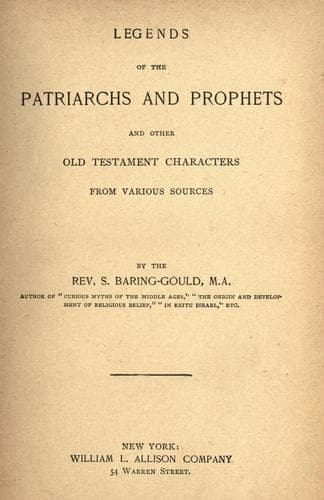
Legends of the Patriarchs and Prophets: And Other Old Testament Characters from Various SourcesBaring-Gould, S. (Sabine)
Religion
Legends of the Patriarchs and Prophets: And Other Old Testament Characters from Various Sources
Baring-Gould, S. (Sabine)
Bible. Old Testament -- Legends
“But very wonderful is the confirmation of the history as it is related
in Hierapolis. In the neighborhood of that city a great chasm opened
which engulphed all the waters of the Flood. Thereupon Deucalion
erected altars, and dedicated a temple to Here (Atergatis) over the
chasm. I have seen this; it is very small: whether it was once large
but has since become smaller, I cannot say; but I saw that it was
small. For the confirmation of the history the following takes place:
twice in the year the sea-water is brought into the temple. Not only
do the priests bear it, but all Syria and Arabia, and many from beyond
Euphrates, come and carry water. They pour it out in the temple; then
it runs down into the chasm, and, though it may be very small, it
takes in all the water poured into it. This they do, say they, because
Deucalion instituted this rite as a memorial of his deliverance, and of
the mercy of God.”[210]
Equally fully has the Babylonian tradition reached us from the Chaldee
history of the old priest of Bel, Berosus (B. C. 260). The Chaldees
had placed ten kings at the head of this mystic history, which answer
to the ten generations in Genesis before the Flood. The last of these
patriarchs was called Xisuthrus, who is the same as the Biblical Noah.
Berosus relates the story of the Deluge thus: “Under the reign of
Xisuthrus there was a great flood. Kronos (_i. e._, Bel) appeared to
Xisuthrus in a dream, and warned him that all men would be destroyed
by a deluge on the 15th of the month Dæsios, and he commanded him to
write down all the learning and science of men, and to hide it in the
sun-city Siparis, and then to build a ship and to enter it along with
his family and relatives and nearest friends, and to take into it with
him food and drink, and beasts and winged fowl. When he was asked
whither he was about to sail, he was bidden reply: To the gods, to pray
them that men may prosper. He obeyed; and made an ark five stadia long
and two wide, laid in what was commanded, and sailed with his wife
and child and relatives. When the flood abated, Xisuthrus sent out a
bird which, as it found no food nor ground on which to perch, returned
to the ship. After a day, he sent out another bird; this came back
with mud on its feet. The third bird he sent out did not return. So
Xisuthrus knew that the land appeared, and he broke a hole in the ship
and saw that the ship was stranded on a mountain; so he disembarked
with his wife and daughter and steersman; and when he had adored the
earth, raised an altar, and offered to the gods, he vanished. Those
who remained in the ship also went out, when they saw that Xisuthrus
did not return, to seek Xisuthrus, and they called him by name. But
Xisuthrus appeared again no more, only his voice was heard bidding
them fear God, and telling them that he had taken to dwell with the
gods, because he was pious. The same honor was accorded to his wife and
daughter and to the steersman.” This refers to their being set in the
Public-domain text, read in full here on John Shaqi.
Reviews
Reviews
No reviews yet
Be the first to share your thoughts on this work.
Elsewhere in the archive
Join the Discussion
Join the discussion
Sign in to leave a comment or review.
Sign InorCreate an account