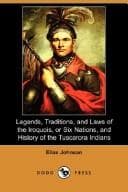
Legends, Traditions, and Laws of the Iroquois, or Six Nations, and History of the Tuscarora IndiansJohnson, Elias
History
Legends, Traditions, and Laws of the Iroquois, or Six Nations, and History of the Tuscarora Indians
Johnson, Elias
Iroquois Indians; Tuscarora Indians
To confer with him on the subject, Mr. Treat requested Mr. Rockwood, Miss
Thayer and her associates to meet him in Buffalo, where he would stop on
his way to the meeting of the American Board at Cincinnati. The result of
the conference: The boarding school was transferred to the immediate care
of the Board, with Mr. Rockwood as Superintendent; the ladies to retain
their respective positions--teacher, house-keeper and matron. From this
time Miss Thayer felt greatly fettered, and the impression grew upon her
that her presence was not desired at Mt. Hope; that her usefulness there
was at an end. Long and prayerfully did she weigh the matter, and at
last, though it nearly broke her heart, she asked to be dismissed from
the field. Her request was granted, and Miss Thayer closed her labors at
Mt. Hope, December 31, 1853, _and longed to die_. It was the saddest
day of her life, the bitterest trial she ever experienced, this giving up
all her hopes of usefulness among her beloved Tuscaroras. She knew not
whither to go; could not tell the people what she had done.
Samuel Jacobs was going to Cattaraugus, and Miss Thayer went with him,
hoping the Lord would give her work to do there. Engaged temporarily in
teaching, was there until the latter part of July, 1854; in August
applied to the Presbyterian Board for an appointment as missionary
teacher for one of their schools among the Southwestern Indians, which
was granted, and she was sent to the Chickasaws, in the Indian Territory;
arrived there in November, 1854; labored among the Chickasaws, Creeks and
Choctaws until September, 1865, when again broken down in health, she
reluctantly gave up the work of a missionary teacher, and returned to her
father's house in Bristol, Wis., accompanied by her husband, (Theodore
Jones), and her three young children (two sons and a daughter). She has
since resided in Bristol, Wis., on the farm given to her by her father
and brothers, a quiet, pleasant home. Her children are growing up in the
fear of the Lord, having all of them, five years ago, (in April, 1873),
united with the Congregational church in Bristol. Although she has not
the means to give them a liberal education, she hopes that they will be
useful workers in the Lord's vineyard.
Mrs. Jones often thinks of her beloved Tuscaroras, and would gladly visit
them if it were not for the expense of such a journey.
Mrs. Jones has culled the material for the foregoing pages from numerous
letters written to her father, from Tuscarora, and also made extracts
from her private journal, kept whilst at Tuscarora, and she gives Elias
Johnson leave to embody such portions of it in his history of the
Tuscaroras as shall best suit his purpose. She sends herewith Mr. Treat's
reply to her request to be released from the work at Mt. Hope; also a
letter written by the Tuscarora chiefs, representing her departure from
their people."
"MRS. MARY J. E, JONES,
"February 22, 1878.
"Bristol, Wis."
To ELIAS JOHNSON, Tuscarora.
Public-domain text, read in full here on John Shaqi.
Reviews
Reviews
No reviews yet
Be the first to share your thoughts on this work.
Elsewhere in the archive
Join the Discussion
Join the discussion
Sign in to leave a comment or review.
Sign InorCreate an account