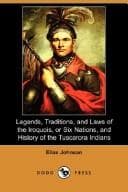
Legends, Traditions, and Laws of the Iroquois, or Six Nations, and History of the Tuscarora IndiansJohnson, Elias
History
Legends, Traditions, and Laws of the Iroquois, or Six Nations, and History of the Tuscarora Indians
Johnson, Elias
Iroquois Indians; Tuscarora Indians
This is the honor of the Tuscarora hero. How many among those of the
white people who receive a pension would have done likewise, for
conscience sake. Cusick could speak the English language very well, but
when he made an audible prayer, or said grace at the table, he used his
native Tuscarora language, "because," said he, "when I speak in English,
I am often at a loss for a word; when, therefore, I speak to the Great
Spirit, I do not like to be perplexed, or have my mind distracted to look
after a word, when I use my own language, it is like my breath, I am
composed." In this is exemplified that he fully understood the reverence
which was due to the great Architect of the universe.
Solomon Longboard, also a Tuscarora Sachem, took an active part in the
Revolutionary war, with many others of his nation. In one of their
scouting parties, he, with others, was taken captive by the British
Indians and brought to fort Niagara, where they were kept for some time,
and urged to take up arms and fight against the revolutionists. Finally,
this celebrated sachem, Longboard, held a secret council among the
captives, and instructed them all to take arms and advance with the
British Indians, and use their influence to lead them to a place where
they might be captured, and they with the rest, which they successfully
effected, and were re-captured by the Americans. Instead of gaining honor
and laurels to his crown, he was to be sentenced to be shot as a traitor,
but through the entreaties of the Tuscarora chiefs, and the influence of
the feasibility of their story that was made on the executives, he was
released, but never drew pension as did Mr. Cusick.
The Tuscaroras again evinced their friendship for the United States in
the war of 1812, when they were asked to guard the Niagara river at
Lewiston and down the river, against the British crossing it.
Here again we hear of the Tuscarora sachem, Solomon Longboard, with about
thirty-five Tuscarora volunteers, stationed at Lewiston on guard. I have
recorded some of the names of these volunteers, which I was able to
obtain from some of the old people that were yet living in the year 1878,
which are as follows, to-wit: The two sons of Solomon Longboard, Jacob
Taylor, Joseph Cusick, John Cusick, David Cusick, John Black Nose and his
brother, Samuel Thompson, John Obediah, Aaron Pempleton, James Pempleton,
John Mt. Pleasant, Harry Patterson, John Green, Isaac Allen, Capt.
Williams, Gau-ya-re-na-twa, Wm. Printup, better known as little Billy,
Black Chief, John Printup, Isaac Green, Surgin Green, George Printup.
There were but few of these that drew pension, as it was alleged that
they were not enrolled upon the army roll.
Public-domain text, read in full here on John Shaqi.
Reviews
Reviews
No reviews yet
Be the first to share your thoughts on this work.
Elsewhere in the archive
Join the Discussion
Join the discussion
Sign in to leave a comment or review.
Sign InorCreate an account