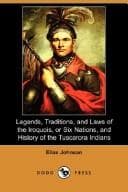
Legends, Traditions, and Laws of the Iroquois, or Six Nations, and History of the Tuscarora IndiansJohnson, Elias
History
Legends, Traditions, and Laws of the Iroquois, or Six Nations, and History of the Tuscarora Indians
Johnson, Elias
Iroquois Indians; Tuscarora Indians
About midday on Wednesday, October 1, the council commenced. The
ceremonies with which it was opened and conducted were certainly unique--
almost indescribable; and as its proceedings were in the Seneca tongue,
they were in a great measure unintelligible, and in fact, profoundly
mysterious to the pale faces. One of the chief objects for which the
council had been convoked, was to fill two vacancies in the Sachems of
the Senecas, which had been made by the death of the former incumbents;
and preceding the installation of the candidates for the succession there
was a general and dolorous lament for the deceased Sachems, the utterance
of which, together with the repetition of the laws of the confederacy,
the installation of the new Sachems, the impeachment and disposition of
three unfaithful Sachems, the elevation of others in their stead, and the
performance of the various ceremonies attendant upon these proceedings,
consumed the principal part of the afternoon.
At the setting of the sun a bountiful repast, consisting of an
innumerable number of rather formidable looking chunks of boiled fresh
beef, and abundance of bread and succotash, was brought into the council
house. The manner of saying grace on this occasion was indeed peculiar. A
kettle being brought, hot and smoking from the fire, and placed in the
center of the council house, there proceeded from a single person, in a
high shrill key, a prolonged and monotonous sound, resembling that of the
syllable _wah_ or _yah_. This was immediately followed by a
responsive but protracted tone, the syllable _whe_ or _swe_,
and this concluded grace. It was impossible not to be somewhat mirthfully
affected at the first hearing of grace said in this novel manner. It is,
however, pleasurable to reflect that the Indians recognize the duty of
rendering thanks to the Divine Being in some formal way for the bounties
and enjoyments which He bestows; and, were an Indian to attend a public
feast among his pace faced brethren, he would be affected perhaps to a
greater degree of marvel at witnessing a total neglect of this ceremony
than we were at his singular way of performing it.
After supper commenced the dances. All day Tuesday and on Wednesday, up
to the time that the places of the deceased Sachems had been filled,
everything like undue joyfulness had been restrained. This was required
by the respect customarily due to the distinguished dead. But now the
bereaved Sachems being again filled, all were to give utterance of
gladness and joy. A short speech by Capt. Frost, introductory to the
enjoyments of the evening, was received with acclamatory approbation, and
soon eighty or ninety of these sons and daughters of the forest--the old
men and the young, the maidens and the matrons--were engaged in the
dance. It was indeed a rare sight.
Public-domain text, read in full here on John Shaqi.
Reviews
Reviews
No reviews yet
Be the first to share your thoughts on this work.
Elsewhere in the archive
Join the Discussion
Join the discussion
Sign in to leave a comment or review.
Sign InorCreate an account