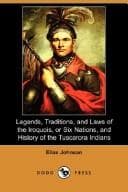
Legends, Traditions, and Laws of the Iroquois, or Six Nations, and History of the Tuscarora IndiansJohnson, Elias
History
Legends, Traditions, and Laws of the Iroquois, or Six Nations, and History of the Tuscarora Indians
Johnson, Elias
Iroquois Indians; Tuscarora Indians
The writer would liked to have said a word or two or relation to the
present condition and prospects of the Indians, but the original design
in regard to both the topics and brevity of this writing having been
already greatly transcended, it must be deferred. The once powerful
confederacy of the Six Nations, occupying in its palmy days the greater
portion of New York State, now number only a little over 3,000. Even this
remnant will soon be gone. In view of this, as well as of the known fact
that the Indian race is everywhere gradually diminishing in numbers, the
writer cannot close without invoking for this unfortunate people renewed
kindliness, sympathy and benevolent attention. It is true, that with some
few exceptions, they possess habits and characteristics which render them
difficult to approach; but still, they are only what the creator of us
all has made them. And let it be remembered, it must be a large measure
of kindliness and benevolence that will repay the injustice and wrongs
that have been inflicted upon them.
ATOTARHO.
Atotarho, who by tradition was an Onondaga, is the great embodiment of
the Iroquois courage, wisdom and heroism, and he is invested with
allegoric traits which exalt him to a kind of superhuman character.
Unequalled in war and arts his fame spread abroad, and exalted the
Onondaga nation in the highest scale. He was placed at the head of the
confederacy, and his name was used after his death as an examplar of
glory and honor. While like that of Caesar, it became perpetuated as the
official title of the presiding Sachem of the confederacy. He was a man
of energy and renown. And such was the estimation in which he was held in
his life time, and the popular veneration for his character after death,
that, as above denoted, his name became the distinctive title for the
office, and is not yet extinct, although the tribes have no longer war to
prosecute or foreign embassadors to reply to.
* * * * *
IROQUOIS LAWS OF DESCENT.
At the establishment of the confederacy, fifty sachems were founded and
a name assigned to each, by which they are still known, and these names
are kept as hereditary from the beginning to the present time. There were
also fifty sub-sachems, or war chiefs--that is, to every sachem was given
a war chief, to stand behind him to do his biddings. These sachemships
were, and are still confined to the five nations; the Tuscaroras were
admitted into the confederacy without enlarging the framework of the
league, by allowing them their own sachems and sub-sachems, or war
chiefs, as they inherited from their original nation of North Carolina.
Public-domain text, read in full here on John Shaqi.
Reviews
Reviews
No reviews yet
Be the first to share your thoughts on this work.
Elsewhere in the archive
Join the Discussion
Join the discussion
Sign in to leave a comment or review.
Sign InorCreate an account