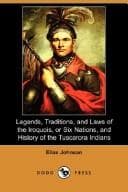
Legends, Traditions, and Laws of the Iroquois, or Six Nations, and History of the Tuscarora IndiansJohnson, Elias
History
Legends, Traditions, and Laws of the Iroquois, or Six Nations, and History of the Tuscarora Indians
Johnson, Elias
Iroquois Indians; Tuscarora Indians
Whatever may be the theories on the subject of Indian civilization, I
think it must be evident that the present position of the Tuscarora
nation on their reservation, is extremely favorable for the attainment of
that object. They can no longer live by the chase. It is not now with
them as it was with the Indians on the Delaware, when William Penn said,
"their pleasures feed them--hunting, fishing and fowling." Surrounded by
the white settlements, placed in the vicinity of cities and towns, they
are obliged to apply to agriculture and other modes of labor, for the
means of subsistence. They are now building good houses, planting
orchards of various kinds of fruit, raising stock, etc.; they have horses
and carriages. Artificial wants--the very pillars of civilization--are
increasing upon them. These require exertion, call into action their
mental faculties, force them to provide for coming exigencies, gradually
tames down their wild nature, and prepares them for that subdued, but
improved state, in which alone is to be found the highest point of
cultivation, as well as the highest enjoyment intended for man in this
probationary world.
If this experiment fails, we may, with melancholy, certainly look forward
to a period when this futile branch of the human family shall be swept
into oblivion, when the fine sounding names of the lofty mountains, the
noble rivers, the splendid cataracts, the great inland seas and the
silvery lakes will be the sole memorials of a race, that, only two or
three centuries ago, covered the face of this vast continent.
On the other hand, if this experiment should succeed, it will open a door
of hope for the preservation, or if we may use the term, physical
salvation of this apparently doomed race. It may encourage the
philanthrophist to stretch forth his hand for the protection of the yet
remaining tribes beyond the Mississippi; and the child may already be
born, who will live to behold that vast wilderness thickly dotted over
with Indian communities, with towns, villages, farms and manufacturing
hamlets. They may live to see the hoe and the spade take the place of the
bow and the tomahawk; the lion and the lamb feeding together; the sword
beaten into a plowshare, and the spear into a pruning hook.
DOMESTIC.
In the first place, to women, in every well regulated society, should be
committed the management of the families and the business connected with
the household concerns, and they should be qualified to exercise a
salutary influence within their appropriate sphere.
Secondly, as mothers they are responsible for the nursing and rearing of
their children and for the proper sustenance of them in early life. They
are also responsible for the habits of their children, including
cleanliness and general propriety of behavior.
Public-domain text, read in full here on John Shaqi.
Reviews
Reviews
No reviews yet
Be the first to share your thoughts on this work.
Elsewhere in the archive
Join the Discussion
Join the discussion
Sign in to leave a comment or review.
Sign InorCreate an account