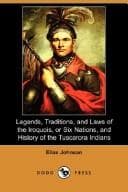
Legends, Traditions, and Laws of the Iroquois, or Six Nations, and History of the Tuscarora IndiansJohnson, Elias
History
Legends, Traditions, and Laws of the Iroquois, or Six Nations, and History of the Tuscarora Indians
Johnson, Elias
Iroquois Indians; Tuscarora Indians
Of the Six Nations, once the owners and lords of the soil within the
boundaries of the great Commonwealth of New York, there were many small
remnants scattered over the western part of this State in a condition of
wretched vagrancy; reduced by idleness and intemperance to poverty, and
ready, for a trifling compensation, to have their names attached to any
memorial, without regard to its objects, for a small sum of money they
would lend themselves to the service of any artful intriguer whose
designs were to defraud the Government.
By an act of Congress passed on the 3rd day of April, 1843, the sum of
twenty thousand four hundred and seventy-seven dollars and fifty cents
was appropriated for the removal of two hundred and fifty Indians to the
countries west and south of the Missouri river.
This appropriation was granted in consequence of repeated assurances made
to the Indian department that this number were anxious to emigrate. The
glittering prize thus hung up in the face of the noon-day sun was so
bright and alluring that a goodly number of hungry candidates were soon
seen entering the lists and struggling for the prize. But, alas! for the
conditions; unless two hundred and fifty Indians could be procured to
enrol themselves on the emigration engagement, and actually embark for
the West, the stakes could not be legally won. Here was the great
difficulty. And yet one would suppose that out of four thousand eight
hundred and eighty-five Indians, belonging to the following tribes, to
wit: the Senecas, Onondagas, Cayugas, Tuscaroras, Oneidas, St. Regises,
Stockbridges, Munsees and Brothertowns, by taking up all the poor,
degraded individuals, and gathering together all the sincere
emigrationists, such a small proportion of the whole might easily be
procured; especially if these candidates for an agency had told the truth
when they asserted that _large bodies of the Indians were anxious to
remove_. By these movements the Government had been induced to believe
that there really was an emigration party sufficiently large to meet the
objects of the late appropriation, and to warrant the appointment of an
emigration agent. Under this impression, the Secretary of War, by a
letter dated Sept. 12, 1845, addressed to Dr. Abraham Hogeboom, appointed
him to that office, instructing him, however, that no movement was to be
made unless the full complement of emigrants should desire, in good
faith, to remove to the West, and Hogeboom was also explicitly informed
that "the Government would not undertake the emigration of these Indians
unless _two hundred and fifty_ of them, then residing in the State
of New York, exclusive of the Canada Indians, should muster themselves
and actually go with the agent."
Public-domain text, read in full here on John Shaqi.
Reviews
Reviews
No reviews yet
Be the first to share your thoughts on this work.
Elsewhere in the archive
Join the Discussion
Join the discussion
Sign in to leave a comment or review.
Sign InorCreate an account