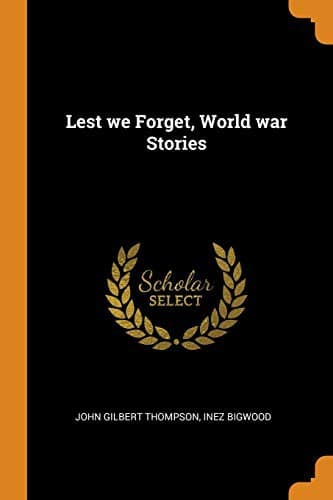
Lest We Forget: World War StoriesThompson, John G. (John Gilbert)
History
Lest We Forget: World War Stories
Thompson, John G. (John Gilbert)
Readers -- History; Readers -- World War, 1914-1918
Shortly after General Pershing reached France, the French people
celebrated the birthday of Lafayette; and General Pershing visited the
tomb of the great French patriot, to place there a wreath in token of
America's gratitude. A large number of French people were gathered
there, and every one supposed General Pershing would make a
speech--that is, every one except General Pershing. When he was called
upon, he was dumfounded, but at last he said, "Well, Lafayette, we are
here." That was all.
Could he have said more if he had talked an hour? He said, "Lafayette,
your people now need us. We have not forgotten. Here we are, and behind
us are all the resources of the wealthiest and most enterprising nation
in the world, billions of dollars and millions of men. We are only the
first to arrive to pay the debt we have owed to you for one hundred and
forty years, but here we are at last."
It is said that men and women wept aloud as the full significance of
the words and all they meant for France became clear to them.
THE MELTING POT
America has been called the "crucible" or the "melting pot" of nations,
because many peoples of many races and many countries come together
here, and in the heat of life and struggle are molded into Americans.
President Wilson said, in a speech at Cincinnati in 1916, "America is
not made out of a single stock. Here we have a great melting pot."
As soon as we entered the war against Germany, the question arose in
the minds of most people as to how the large number of Germans in the
United States would act. Germany had taught them that even though they
became naturalized and took the oath of allegiance as American
citizens, such action was not binding, but was like "a scrap of paper"
to be destroyed and forgotten whenever necessity demanded, and that
"once a German" meant "always a German." It seems now that Germany
actually expected the Germans, who had left their native land to seek
opportunity, freedom, and citizenship under the Stars and Stripes, to
fight against their new and adopted home; but events have proved that
most German-Americans have higher ideals of right. A leading
German-American has written a book entitled "Right before Peace"; its
title carries the thought that has guided most of his fellow-countrymen
and their children in the United States during the World War.
A few months after the United States had declared that a state of war
existed with Germany, many leading men of this country of foreign birth
and parentage, signed, with others, a declaration drawn up by Theodore
Roosevelt. This declaration, somewhat abbreviated but not altered in
thought, is as follows. It makes very clear what America should mean to
her adopted children.
Public-domain text, read in full here on John Shaqi.
Reviews
Reviews
No reviews yet
Be the first to share your thoughts on this work.
Elsewhere in the archive
Join the Discussion
Join the discussion
Sign in to leave a comment or review.
Sign InorCreate an account