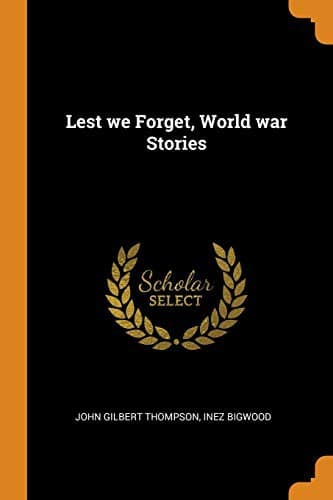
Lest We Forget: World War StoriesThompson, John G. (John Gilbert)
History
Lest We Forget: World War Stories
Thompson, John G. (John Gilbert)
Readers -- History; Readers -- World War, 1914-1918
"Let us think this matter out more closely. The follower of Tolstoy
will say: 'We speak of Belgium's honor and Serbia's honor; but who is
Serbia and who is Belgium? There is no such person as either. There are
only great numbers of people who happen to be Serbians and Belgians,
and who mostly have had nothing to do with questions at issue. Some of
them are honorable people, some dishonorable. The honor of each one of
them depends very much on whether he pays his debts and tells the
truth, but not in the least on whether a number of foreigners walk
through his country or interfere with his government. King Albert and
his ministers might feel humiliated if the German government compelled
them to give way against their will; but would the ordinary
population? Would the ordinary peasant or shop-keeper or artisan in the
districts of Vise and Liége and Louvain have felt particularly
disgraced or ashamed? He would probably have made a little money and
been greatly amused by the sight of the troops passing. He would not
have suffered any injury that can for a moment be compared with what he
has suffered now, in order that his government might feel proud of
itself.'
"I will not raise the point that, as a matter of fact, to grant a right
of way to Germany would have been to declare war against France, so
that Belgium would not, by giving up her independence, have been spared
the danger of war. I will assume that it was simply a question of
honor. And I believe that our follower of Tolstoy is very wrong.
"Is it true, in a healthy and well-governed state, that the average
citizen is indifferent to the honor of his country? We know that it is
not. True, the average citizen may often not understand what is going
on, but as soon as he knows, he cares. Suppose for a moment that the
King, or the Prime Minister, or the President of the United States,
were found to be in the pay of a foreign state, can any one pretend
that the ordinary citizens of Great Britain or America would take it
quietly? That any normal man would be found saying: 'Well, the King, or
the President, or the Prime Minister, is behaving dishonorably, but
that is a matter for him, not for me. I am an honest and honorable man,
and my government can do what it likes.' The notion is absurd. The
ordinary citizen would feel instantly and without question that his
country's honor involved his own. And woe to the society in which it
were otherwise! We know of such societies in history. They are the kind
which is called 'corrupt,' and which generally has not long to live.
Belgium has proved that she is not that kind of society.
Public-domain text, read in full here on John Shaqi.
Reviews
Reviews
No reviews yet
Be the first to share your thoughts on this work.
Elsewhere in the archive
Join the Discussion
Join the discussion
Sign in to leave a comment or review.
Sign InorCreate an account