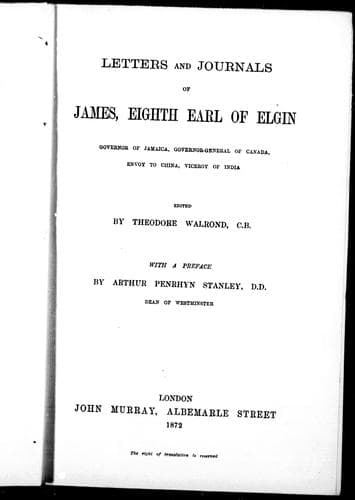
Letters and Journals of James, Eighth Earl of ElginElgin, James Bruce, Earl of
History
Letters and Journals of James, Eighth Earl of Elgin
Elgin, James Bruce, Earl of
Great Britain -- Colonies -- Administration -- History -- 19th century
The Chinese Government, tractable enough under the present influence of a
bold and determined spirit, had returned to its old ways when that pressure
was removed. It had been agreed that the Treaty of Tien-tsin should be
formally ratified within the year, that is, before the 26th of June, 1859;
and, when the time approached, Mr. Bruce was commissioned to proceed to
Pekin for the purpose of exchanging the ratifications. On arriving,
however, at the mouth of the Peiho, he found the Taku forts, which guard
the mouth of the river, fortified against him; and when the men-of-war
which accompanied him went forward to remove the barriers that had been
laid across the river, they were fired upon from the forts. As no such
resistance had been expected, no provision had been made for overcoming it;
and Mr. Bruce had no choice but to return to Shanghae, and report to the
Government at home what had occurred.
For some time it seems to have been hoped that the Emperor of China, when
fully informed of the misconduct of his officers in firing upon British
ships without notice, would have been ready to make the proper _amende_;
but when this hope was dispelled, it became clear that such an outrage must
be summarily dealt with. A large force, both naval and military, was
ordered from England and India to the China seas, to co-operate there with
forces sent by the French, who felt themselves scarcely less aggrieved than
the English by the repudiation of the common Treaty.
For the command of this expedition there was one man whom all parties alike
regarded as marked out at once by character and ability, and by previous
experience. On the 17th of April, 1860, Lord Russell, who was then Foreign
Secretary, wrote officially to Lord Elgin that 'Her Majesty, resolved to
employ every means calculated to establish peace with the Emperor of China,
had determined to call upon him again to give his valuable services to
promote this important object, and had signified her intention of
appointing him to proceed to China as her Ambassador Extraordinary to deal
with these matters.' His instructions were necessarily of the vaguest.
After touching upon some of the awkward contingencies that might arise,
Lord Russell proceeded: 'In these circumstances your 'Lordship and your
enlightened colleague, Baron Gros, will be required to exercise those
personal qualities of firmness and discretion which have induced Her
Majesty and her Ally to place their confidence in you and the French
Plenipotentiary.' The only conditions named as indispensable were, (1) an
apology for the attack on the Allied forces at the Peiho; (2) the
ratification and execution of the Treaty of Tientsin; (3) the payment of an
indemnity to the Allies for the expenses of naval and military
preparations.
Public-domain text, read in full here on John Shaqi.
Reviews
Reviews
No reviews yet
Be the first to share your thoughts on this work.
Elsewhere in the archive
Join the Discussion
Join the discussion
Sign in to leave a comment or review.
Sign InorCreate an account