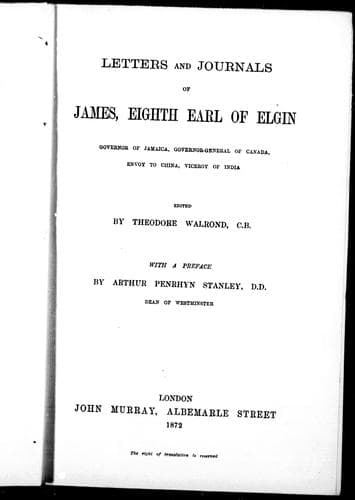
Letters and Journals of James, Eighth Earl of ElginElgin, James Bruce, Earl of
History
Letters and Journals of James, Eighth Earl of Elgin
Elgin, James Bruce, Earl of
Great Britain -- Colonies -- Administration -- History -- 19th century
_July 22nd, Sunday._--The thirteenth since we parted. It seems like as
many months or years. Some one said to-day at breakfast that it is the
last quiet one we are likely to have for a while. In one sense I hope
this may turn out to be true.... To-morrow our cavalry and artillery
are to be embarked. This takes place on the other side of this bay,
and I intend to go over to see the operation.
_July 26th.--Noon._--I am now starting (having witnessed the departure
of the fleet) for the scene of action in the Gulf of Pecheli. The
sight of this forenoon has been a very striking one, just enough
breeze to enable the vessels to spread their sails. We have about 180
miles to go to the point of _rendezvous_.... Meanwhile, one has as
usual one's crop of small troubles. The servants threatened to strike
yesterday, but they were soon brought to reason.
[Sidenote: The _rendezvous_.]
[Sidenote: Jesuit letters.]
_July 27th.--Ten A.M._--We have reached our destination after a most
smooth passage, during which we have followed close in the wake of the
Admiral.... I am reading the 'Lettres édifiantes et curieuses,' which
are the reports of the Jesuit missionaries who were established in
China at the commencement of the last century. They are very
interesting, and the writers seem to have been good and zealous
people. At the same time one cannot help being struck by their
puerility on many points. The doctrine of baptismal regeneration
pushed to its extreme logical conclusions, as it is by them, leads to
rather strange practical consequences. Starting from the principle
that all unbaptized children are certainly eternally lost, and all
baptized (if they die immediately) as certainly saved, they naturally
infer that they do more for the kingdom of heaven by baptizing dying
children than by any other work of conversion in which they can be
engaged. The sums which they expend in sending people about the
streets, to administer this sacrament to all the moribund children
they can find; the arts which they employ to perform this office
secretly on children in this state whom they are asked to treat
medically; and the glee with which they record the success of their
tricks, are certainly remarkable. From some passages I infer that, in
the Roman Catholic view of the case, the rite of baptism may be
administered even by an unbeliever.
[Sidenote: The Pey-tang.]
_Two P.M._--Hope Grant has teen on board. He tells me that the mouth
of the Pey-tang is not staked, and that the 'Actaeon's' boat went
three miles up the river. This river is seven or eight miles from the
Peiho, and the Chinese have had a year to prepare to resist us. It
appears that there is nothing to prevent the gunboats from going up
that river.
Public-domain text, read in full here on John Shaqi.
Reviews
Reviews
No reviews yet
Be the first to share your thoughts on this work.
Elsewhere in the archive
Join the Discussion
Join the discussion
Sign in to leave a comment or review.
Sign InorCreate an account