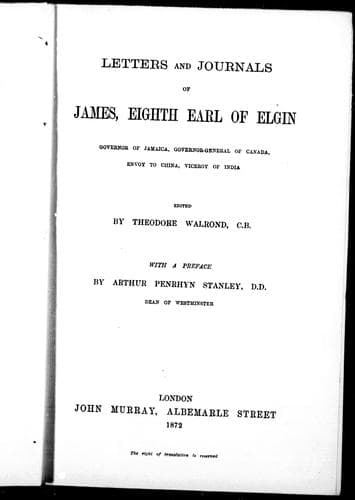
Letters and Journals of James, Eighth Earl of ElginElgin, James Bruce, Earl of
History
Letters and Journals of James, Eighth Earl of Elgin
Elgin, James Bruce, Earl of
Great Britain -- Colonies -- Administration -- History -- 19th century
a while, because a battery opened fire at about fifteen hundred yards
from us, and some of the balls fell so near, that we began to think
they were perhaps firing at me. On being dislodged from my Belvidere,
I took some breakfast to console myself; and soon after, seeing the
British flag on the fort which we had been attacking, I rode over to
it. We met a good many of our own wounded, and all round the fort were
numbers of the poor Chinamen, staked and massacred in all sorts of
ways. I found the two Generals there, and soon after the Admiral came
up from his ship under a flag of truce. Two letters came to me from
the Chinese; but, true to my policy of letting the fighting men have
all the prestige of taking the Forts, I would not have anything to say
to them. The messengers were told that they must give up the forts to
the Commanders-in-Chief before I would listen to them; and that, in
the meantime, the army would proceed with its operations. They moved
on accordingly, and I returned to my post of observation at Tangkow. I
had hardly reached it when the rain began, and in about an hour the
roads had become absolutely impassable for artillery, and nearly so
for everything else. The troops met with no resistance at the second
fort, and the indefatigable Parkes having gone over to the unfortunate
Governor-General, extorted from him a surrender of the whole, which he
brought to the Commanders-in-Chief on the morning of the 22nd, having,
I believe, dictated its terms. Of course, Grant's triumph is complete,
and deservedly so. ... The system of our army involves such an
enormous transportation of provisions, &c., that we make, however, but
slow progress. I have, therefore, urged the Admiral, who has got
through the barriers at the mouth of the Peiho (and who is not
unwilling to go ahead), to proceed up the river with his gunboats: if
he meets with any obstructions which are serious, he can stop his
progress, and await the arrival of troops. If he meets none, he will
soon reach Tientsin.
Public-domain text, read in full here on John Shaqi.
Reviews
Reviews
No reviews yet
Be the first to share your thoughts on this work.
Elsewhere in the archive
Join the Discussion
Join the discussion
Sign in to leave a comment or review.
Sign InorCreate an account