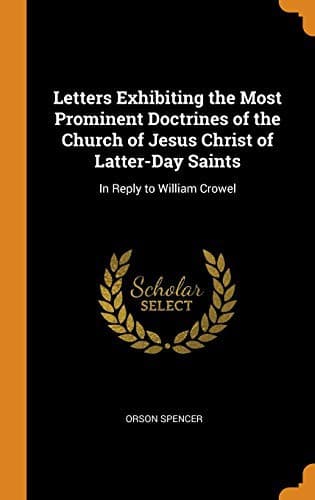
Letters Exhibiting the Most Prominent Doctrines of the Church of Jesus Christ of Latter-Day SaintsSpencer, Orson
Religion
Letters Exhibiting the Most Prominent Doctrines of the Church of Jesus Christ of Latter-Day Saints
Spencer, Orson
Church of Jesus Christ of Latter-day Saints -- Doctrines; Latter Day Saint churches -- Doctrines
You readily say, that the myriads of Asia are deceived and mistaken.
But may they not retort upon you and say--how is it that we, whose
religion is so ancient and so universally believed, should be (all of
us) in such gross error? Now, may not the reply that would fit them
be applicable to the advocates of modern christianity? They are all
the children of Adam as much as you, and as much the offspring of our
common parent. Their rulers and divines are as respectable among their
own countrymen as yours are among your countrymen. It is no worse for
modern christendom to be in error than for paganism. Paganism can
boast of more learning and oratory, and of more universal, enduring,
and mighty governments than modern christianity! Paganism can boast of
more union and stability than modern christianity. But I am no advocate
of either paganism or modern christianity. I believe that the whole
world lieth in darkness, in consequence of transgressing the laws of
God. Modern christianity has had a fair trial for success. Kings and
potentates with vast and populous dominions, have been arrayed on
its side. _Eighteen hundred years_ have testified to its ragged and
crippled march. The sovereigns of Europe and rulers of America are
on its side. But what a haggard picture of union does the theatre
of modern Christianity present! A garment of as many colours as the
various religious creeds of modern christianity, would constitute a
phenomenon fit to be carried about as a curiosity.
In Catholic countries there is the largest share of unity of creeds.
In Protestant countries every city, town, and village presents the
picture of religious collision and jargon. Now, these contending parts
must necessarily be wrong, for God is not the author of confusion, but
of peace. And if the constituent parts are wrong, the aggregate must
also be wrong. But whether the balance of wisdom and virtue lies with
Christians or Pagans, one thing is certain, that no man, by searching,
can find out God or know the Almighty unto perfection! The world by
wisdom know not God. No man can ever know God unless God reveals
himself to him. Those whom God selects to communicate revelations to
men are not the wise and mighty, but rather such as are accounted
weak, and foolish, and unholy. This is the description of men that
God generally chooses to do his work on the earth. Again, it is said
that the doctrines of the Latter-day Saints may be good enough, but
their characters are too reprehensible. Testimony from many reliable
sources is against them; and we have seen with our own eyes a want of
that fervent piety that ought to distinguish a people entrusted with
the ordinances and gifts of salvation.--This, I think, is the most
weighty and popular objection that is urged by the opposers of the
Latter-day Saints:--if they were a respectable people, their doctrines
could better be endured. Now I propose to consider this objection,
Public-domain text, read in full here on John Shaqi.
Reviews
Reviews
No reviews yet
Be the first to share your thoughts on this work.
Elsewhere in the archive
Join the Discussion
Join the discussion
Sign in to leave a comment or review.
Sign InorCreate an account