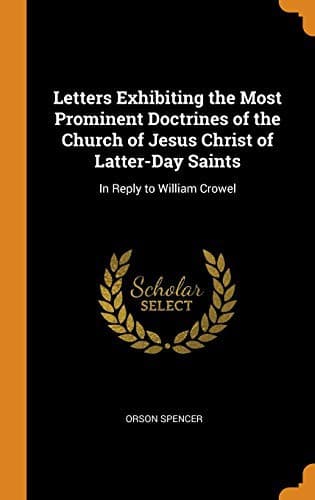
Letters Exhibiting the Most Prominent Doctrines of the Church of Jesus Christ of Latter-Day SaintsSpencer, Orson
Religion
Letters Exhibiting the Most Prominent Doctrines of the Church of Jesus Christ of Latter-Day Saints
Spencer, Orson
Church of Jesus Christ of Latter-day Saints -- Doctrines; Latter Day Saint churches -- Doctrines
You will perceive, sir, a difference in the liability of such persons
as are born during the reign of righteousness, who do not sleep
or die, and those who must die by reason of sin. The former know
not the dominion or sting of sin, but are as trees of the Lord's
planting--righteous. The latter must needs die and be resurrected.
Jesus was the first fruits of them that slept. In the case of all
others, corruption followed death; and a longer period must elapse
before their bodies could be resurrected by reason of corruption. But
Jesus was first and foremost to ripen into immortality. Corruptibility
did not pertain to him, of course it was not necessarily pre-requisite
to his resurrection and immortality; but with all others, down to the
period when it is said that they should not sleep, corruption must
precede the resurrection.--If the body of Jesus did not corrupt and
moulder back to dust, then it is evident that he had substantially the
same sort of corporal frame after his resurrection that he had before.
The spirit resting upon him without measure, animated and resuscitated
his body with no other material change than that of loss of blood. He
shewed his disciples his body, and told them to handle him and see of
what material it was: "a spirit hath not flesh and bones as ye see me
have." He shewed them, demonstratively, in his own person, a proper
specimen of a living resurrected body. He shewed them that a spirit did
not possess flesh and bones as a resurrected body did. He also proved
another thing, viz.: that a resurrected body retains probably all the
five senses common to a mortal body. He eat and drank with them, and
shewed them that his person was identically the same as before his
death.--Here there is a specimen of corporal immortality. In this
person we may see what all resurrected bodies will be, for we shall be
like him. Life and immortality are brought to light in the example of
Christ's resurrected body. Such is the organization of a resurrected
body, in consequence of the expulsion of the seeds of death, the last
enemy, that decay and disease have no further power or influence.
Public-domain text, read in full here on John Shaqi.
Reviews
Reviews
No reviews yet
Be the first to share your thoughts on this work.
Elsewhere in the archive
Join the Discussion
Join the discussion
Sign in to leave a comment or review.
Sign InorCreate an account