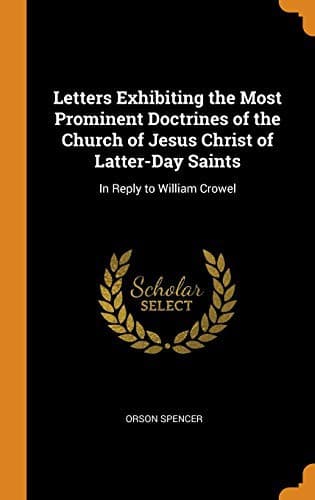
Letters Exhibiting the Most Prominent Doctrines of the Church of Jesus Christ of Latter-Day SaintsSpencer, Orson
Religion
Letters Exhibiting the Most Prominent Doctrines of the Church of Jesus Christ of Latter-Day Saints
Spencer, Orson
Church of Jesus Christ of Latter-day Saints -- Doctrines; Latter Day Saint churches -- Doctrines
Startle not, my dear sir, at this idea that is so repugnant to the
prejudice of protestants. The principle of substitution is at the
foundation of the great work of redemption, and forms a chain of
gratitude and obligation of the purest and noblest metal. Jesus died
for others, because they could not have saved themselves without his
obedience for them. The preachers of righteousness pass through many
tribulations, and sacrifice houses, lands, and country, in order that
others may become rich both temporally and spiritually; without this
order of suffering, the just for the unjust, no man could be saved.
Paul says, I rejoice in my sufferings for you, and fill up that which
is _behind_ of the afflictions of Christ, in my flesh, for his body's
sake, which is the Church. Every man that has the priesthood of
Christ may suffer in his measure and degree a propitiatory sacrifice,
according to the degree of priesthood with which he is clothed. He may
become a subordinate saviour to his fellow-men, Christ being, however,
the CAPTAIN of all men's salvation. Hence, the prophets plumply call
men SAVIOURS who shall be raised to officiate in Mount Zion.
Paul also instructs Timothy how he can _save_ men and himself. This
distribution of _saving_ gifts, instead of eclipsing Jesus of the
glory of salvation, magnifies his glory, because He is the spring and
source of all salvation. God the Father reigns over all, and Jesus
under him, and men reign under Jesus as kings and priests. Kingdoms
rise up within kingdoms, but Christ is the _King_ of kings. Peter tells
how the devout and honourable dead may be saved, who never heard the
gospel on earth. He says, the living may be baptized for them, and
then they can be judged according to men in the flesh. Says he, "else
why are ye baptized for the dead?" Baptism for the dead was better
understood in Peter's days than the doctrine of the resurrection.
Doctrines are sooner obliterated from the mind than ordinances. But
after the destruction of the Temple, and the baptismal font, baptisms
for the dead must of course cease, because there was no longer an
acceptable place for this ordinance to be ministered. Peter explicitly
declares, that the gospel was preached to _the dead_, by which also
he went and preached to the Spirits in prison. Now if the gospel was
preached to the dead, then mercy, and deliverance, and salvation, were
preached to the dead; but these could not be preached to them without
the ordinances, because the ordinances of baptism, and gift of the Holy
Ghost, are a part of the gospel; for except a man is born of water and
of the Spirit, he cannot enter the kingdom of God. But if a righteous
man is baptized for his departed friend, the law requiring baptism is
magnified, and God can justify the departed spirit that believes, and
accepts the same.
Public-domain text, read in full here on John Shaqi.
Reviews
Reviews
No reviews yet
Be the first to share your thoughts on this work.
Elsewhere in the archive
Join the Discussion
Join the discussion
Sign in to leave a comment or review.
Sign InorCreate an account