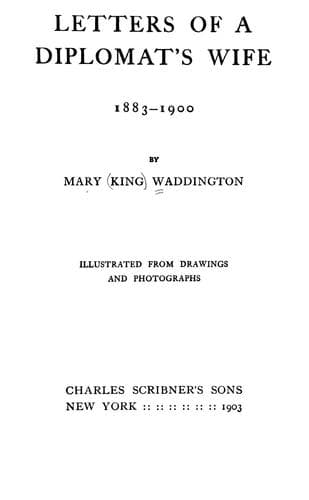
Letters of a Diplomat's Wife, 1883-1900Waddington, Mary King
History
Letters of a Diplomat's Wife, 1883-1900
Waddington, Mary King
Europe -- Social life and customs
Our inspection of the house took us all the morning. The kitchen,
offices, servants' hall and rooms are enormous, and in very bad order. I
should think it would take weeks to get it clean and habitable, and need
an army of servants to keep it so. I am thinking rather sadly of my
little hotel in Paris, so clean and bright, with not a dark corner
anywhere.
We went out driving in the afternoon, and I had my first experience as
Ambassadress, as the coachman drove down Constitution Hill--a right of
way reserved for Royalties and the Corps Diplomatique. We went straight
to Mrs. Brown, the famous milliner, in Bond Street, to get ourselves new
hats, as ours were quite impossible after our very lively passage, and
the housemaid at Albert Gate had a handsome present of two hats with
drooping feathers and a strong smell of sea and salt. London was of
course empty, but a few carriages were in the park, and it amused us to
drive about and see all the shops, and the general look of the streets,
so different from Paris.
We spent our evening quietly at home looking over our installation with
W., horses, carriages, servants, and in fact the complete organisation
of a big London house, which is so unlike a French one. I shall bring
over all my French servants and add as many English as are necessary. I
don't quite see Hubert, our French coachman, driving about the London
streets, and keeping to the left. I should think we should have daily
discussions with all the drivers in London; however, we must try. I
wonder if I shall like being an Ambassadress, and I also wonder how long
we shall stay here. My brother-in-law R. says perhaps two years.
We got back three days ago--started on a bright summer's day. The
Ambassador and secretaries came down to the station to see us off, and
W. promised to come over and spend Sunday. We had an ideal
crossing--blue sky, bright sun, and few passengers, and, notwithstanding
our hard experience in the first passage, we are glad to have been over
and made acquaintance with the personnel of the Embassy, also to have
seen the house and realized a little what I must bring over to give it a
look of home.
This morning we have the news of the Comte de Chambord's death, and I am
wondering if it will make any political complication. However, for years
past he has only been a name--a most honourable one certainly--but one
wants more than that to deal with the present state of France.
After all W. never came over. Although London was empty, he had always
some business to attend to, and on Sunday usually went to see some
friends in the country. Last Sunday he spent with Lord Granville at
Walmer, which he said was delightful. The castle so close to the sea
that the big ships passed almost under the windows; Granville himself a
charming host. He knows France and the French well, having been a great
deal in Paris as a boy when his father was British Ambassador to Louis
Philippe (1830-4); Lord Palmerston was then British Foreign Secretary.
Public-domain text, read in full here on John Shaqi.
Reviews
Reviews
No reviews yet
Be the first to share your thoughts on this work.
Elsewhere in the archive
Join the Discussion
Join the discussion
Sign in to leave a comment or review.
Sign InorCreate an account