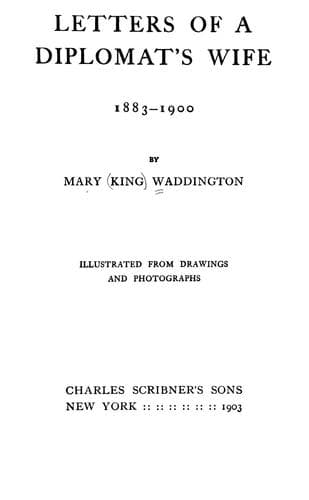
Letters of a Diplomat's Wife, 1883-1900Waddington, Mary King
History
Letters of a Diplomat's Wife, 1883-1900
Waddington, Mary King
Europe -- Social life and customs
There was a large reception after dinner and the mistress of the house
asked us if we wouldn't stand by the Queen and make a sort of cercle,
and a funny contrast we made--Mrs. P. beautifully dressed in white satin
and lace, Lady R. with splendid jewels, I wore my pink brocade and old
Venetian lace. It really was too absurd. I talked a little to the
Princess, who is intelligent enough. The Queen is a great stickler for
etiquette, and insisted upon the same honours as any other Royalties, an
escort of _Life Guards_;--wouldn't accept any less distinguished escort.
#London#,
June 18, 1887.
We have had rather an amusing afternoon. I think I wrote you that we
wanted to leave Westminster Abbey the minute the ceremony was over, get
through the line of troops, and back to a friend's house in Piccadilly
to see the cortege--we being Mrs. Phelps and I. Our respective husbands
were most discouraging (as men always are), but we dined last night with
Knowles to meet the Duke of Cambridge, and I told His Royal Highness
what we wanted to do, and asked him if he could help us. After some
little discussion he said he would advise us to go directly to Sir
Charles Warren (Chief of Police) and see what he could arrange for us.
Again our husbands remonstrated, "Warren was overrun with applications
of all kinds, worked to death, and it was very unreasonable," but backed
by the Duke we determined to try.
I told His Royal Highness I should put on my most becoming Paris bonnet
and beard the lion in his den. He said, "Quite right, my dear, a man is
always flattered when a woman tries to please him," so accordingly about
3 Mrs. Phelps and I started for Scotland Yard. George was rather
surprised when I gave the order. We drove through one or two courts and
were stopped once by a huge policeman, who let us go on when we said it
was the French Ambassadress. We were shown at once into Sir Charles's
room, and I must say he was charming, most kind and courteous. We had
arranged beforehand that I was to be spokeswoman, and I went at once to
the point. He was sitting at his table with letters and papers and
telegrams, the telegraph ticking all the time, despatches and telegrams
being brought in, and as busy a man as I ever saw. He immediately sent
for maps of the route, distribution of the troops, etc., and said he
thought he could manage it. We must have a light carriage (of course we
must go to the Abbey in state in the gala coach) waiting at the Poets'
Corner, as near the door as it can get; he will send us a pass to break
through the lines, and will have three or four policemen waiting for us
at the corner of Piccadilly and one of the smaller streets to pass us
through the crowd. We really didn't derange him very much. The whole
conversation lasted about ten minutes, and he was rather amused at this
sudden appearance of the two "femmes du monde" in his "milieu" of
clerks, policemen, telegraph boys, type-writers and a hurrying, bustling
Public-domain text, read in full here on John Shaqi.
Reviews
Reviews
No reviews yet
Be the first to share your thoughts on this work.
Elsewhere in the archive
Join the Discussion
Join the discussion
Sign in to leave a comment or review.
Sign InorCreate an account