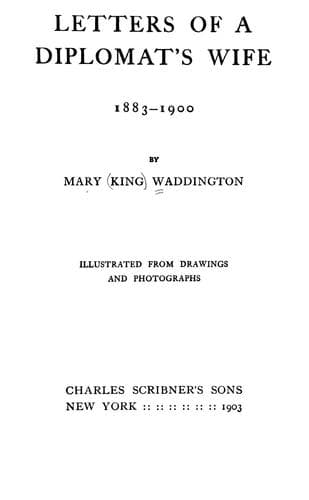
Letters of a Diplomat's Wife, 1883-1900Waddington, Mary King
History
Letters of a Diplomat's Wife, 1883-1900
Waddington, Mary King
Europe -- Social life and customs
always to keep up good and friendly relations with England, and that he
had had much sympathy from all sides, he was much cheered; but much more
when he said that perhaps what had given him more friends in England
than any of his public acts as a statesman was the fact that he had
rowed in the University eight at Cambridge. Then there were roars of
applause, and he heard quite distinctly the people below saying--"he is
quite right, we always remember it." He was quite emu when he came to
the end; his voice taking that grave tone I like so much when he said
"good-bye." One heard every word. He was much cheered when he finished.
The Lady Mayoress came and shook hands with me and asked me if I wasn't
proud of my husband. Some of the speeches were charming--the Speaker's
particularly; Lord Lorne also made a very pretty little speech, and
Rustem (Turk), who answered the toast for the "Corps Diplomatique," made
a very good speech. I can't remember all the names and all the speeches,
but it was a most brilliant assembly, and as Countess Deym said to me, a
wonderful tribute to W. As soon as the speeches were over we all went
down to the great hall, where I had a perfect defile of compliments and
regrets, Lord Lorne again repeating his words "that W.'s departure was a
national calamity." All had something friendly to say--the two Law
Lords, Judge Bowen and Sir Francis Jeune, most sympathetic. S. too told
me I should be much pleased--he had never seen such a demonstration in
England for a foreigner. Of course some of the young men came in to the
Embassy to talk the dinner over, and gave their impressions. They were
all much pleased. W. certainly was, and said he felt quite emu when he
saw all the faces turned to him and knew that every word he said would
tell--also he knew quite well that his reference to the boat-race would
appeal much more to the _general_ public than any expressions of good
feeling toward England. He hasn't always had an easy time with his
English name and his English education. Of course it has been very
useful to him here, as he has been thrown with all sorts of people, and
could understand the English point of view, but in France they were
always afraid he was too English. I think when he has gone they will
realise at home what good work he has done here _because_ he understands
them.
#French Embassy, London#,
March 8, 1893.
Public-domain text, read in full here on John Shaqi.
Reviews
Reviews
No reviews yet
Be the first to share your thoughts on this work.
Elsewhere in the archive
Join the Discussion
Join the discussion
Sign in to leave a comment or review.
Sign InorCreate an account