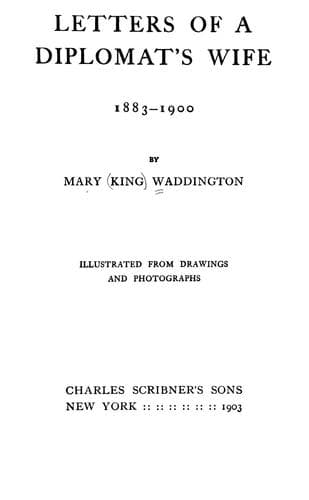
Letters of a Diplomat's Wife, 1883-1900Waddington, Mary King
History
Letters of a Diplomat's Wife, 1883-1900
Waddington, Mary King
Europe -- Social life and customs
We had a charming day; I am so glad we went. We started a little after
ten for Frankfort, where we had a wait of 20 minutes. I wore my black
voile and a little black and jet toque in which I put a white aigrette,
and white gloves, so as not to be too black. The trajet is short from
Frankfort to Cronberg, about an hour. We found two carriages (rather
pretty victorias in wood natural colour and cushions the same
colour--they looked very chic and country) and tall powdered footmen in
the black and silver Imperial livery. There were two or three people in
the second carriage whom I didn't recognise at first, but made out when
we arrived. Val Prinsep, the artist, and his wife, a very pretty woman,
and a German lady, also an artist I think. The Castle is not far from
the station, and Cronberg (the town) is rather picturesque. The house is
large--nothing particular in the way of architecture, but stands well in
a fair-sized park. We were received in a fine hall, with pictures,
carvings, and plenty of old furniture. Countess Perponcher and Baron
Reischach received us. Count Seckendorff was not there, which I
regretted, as I like him very much and should have been glad to see him
again. Countess Perponcher took us to a small room on the ground floor
where we left our parasols, wraps, etc., and then we went through one or
two handsome rooms into a large salon where the company was already
assembled. Lady Layard and her niece were staying in the house, also
Prince Albert Solms (our old friend) with his wife. He is very ill, poor
fellow, and can hardly get about. Some English friends arrived from
Hombourg--Lady Cork, Lord Algy Lennox. About 1.30 the Empress
came--always the same charming manner, and always her sad eyes. I
thought she looked thinner and paler perhaps, but not ill. We went
immediately to luncheon--the Empress first, alone, all of us following.
Baron Reischach sat opposite to her, between me and Lady Cork. The talk
was easy, the Empress talking a great deal. Val Prinsep too did his
share, and Lady Cork is always clever and original. After luncheon we
went back to the big drawing-room and looked at some of the beautiful
things. Angeli's last portrait of the Empress had just come and had been
placed (temporarily only) in a corner where the light was not very good.
It is a fine picture--the Empress all in black with her splendid pearl
necklace, seated on a sort of carved throne, or high-backed chair--all
the shading dark, the only bit of colour the yellow ribbon of the Black
Eagle. It is a striking picture and very like her, but so inexpressibly
sad. She called each one of us in turn to come and sit by her. She spoke
very warmly of W. to me, and asked me if I didn't regret my London life,
and if I did not find it very difficult to settle down in France after
having lived ten years in London, "the great centre of the world." It is
curious how universal that feeling is with English people (and "au
Public-domain text, read in full here on John Shaqi.
Reviews
Reviews
No reviews yet
Be the first to share your thoughts on this work.
Elsewhere in the archive
Join the Discussion
Join the discussion
Sign in to leave a comment or review.
Sign InorCreate an account