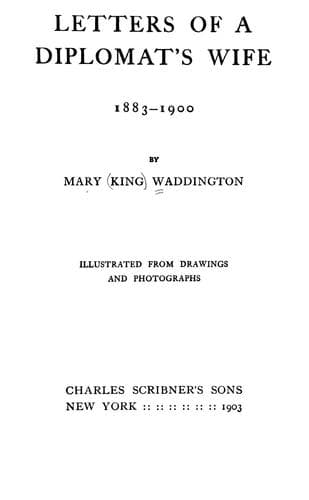
Letters of a Diplomat's Wife, 1883-1900Waddington, Mary King
History
Letters of a Diplomat's Wife, 1883-1900
Waddington, Mary King
Europe -- Social life and customs
The soupiere was preceded by a chamberlain in gold lace; held by a
Master of Ceremonies, and flanked on each side by a gigantic
Chevalier-garde, sabre-a-nu. There was always a collection of officials,
chamberlains, pages, etc., bringing up the rear of the cortege, so that
at each entree a little procession appeared. We saw three dishes brought
in with the same ceremony--the fish was so large on a large silver dish
that _two_ Masters of Ceremonies held that.
It was really a wonderful sight, like a picture in some old history of
the Moyen Age. As soon as the Sovereigns had taken their places on the
thrones all the Russians at their table sat down too. We couldn't,
because we had nothing to sit upon, so we remained standing at the end
of the room, facing the estrade. They told us that when the Emperor
raised his glass and asked for wine that was the signal for us to
retire; and that it would be after the roast. (All our instructions were
most carefully given to us by Benckendorff, who felt his
responsibility.) Think what his position would have been if any member
of _his_ Embassy had made a "gaffe." Accordingly as soon as the roast
made its appearance all our eyes were riveted upon the Emperor. He
raised his glass slowly (very high) to give us time. General Schweinitz,
as Doyen, stepped well forward, and made a very low bow. We all bowed
and curtseyed low (my knees are becoming more supple) and got ourselves
out backwards. It wasn't very difficult, as we had our trains over our
arms.
I don't think we shall see anything more curious than that state
banquet. I certainly shall never see again a soup tureen guarded by
soldiers with drawn swords.
10 o'clock.
We dined quietly, everyone giving his experiences--of course the younger
members of the Embassy, who had no places in the church, had a better
impression of the ensemble than we had. They said the excitement
and emotion of the crowd in the square before the church was
extraordinary. All crossed themselves, and many cried, when the cannon
told them that the Emperor was crowned. They seem to be an emotional,
superstitious race. They also said the procession around the courts,
when the Emperor and Empress were going to the various churches, was
wonderful--a moving mass of feathers, jewels, banners, bright helmets,
and cuirasses, all glittering in the sun.
After dinner we drove about a little, seeing the illuminations, but the
crowd was so dense we could hardly move, though the soldiers did all
they could, and battered the people about. Then it began to rain a
little, so I begged to come home. It is raining quite hard now--I
hear it on the marquise. Heavens how tired I am.
Of course I can't write half of what I have seen, but the papers will
keep you quite au courant. Some of the newspaper correspondents were in
the church, and of course plenty in the tribunes outside. Our carriages
certainly made a great effect, and we were cheered various times on our
way home.
Public-domain text, read in full here on John Shaqi.
Reviews
Reviews
No reviews yet
Be the first to share your thoughts on this work.
Join the Discussion
Join the discussion
Sign in to leave a comment or review.
Sign InorCreate an account