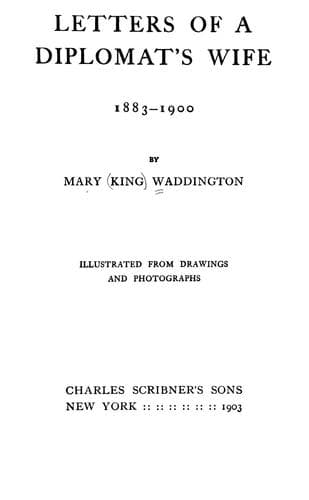
Letters of a Diplomat's Wife, 1883-1900Waddington, Mary King
History
Letters of a Diplomat's Wife, 1883-1900
Waddington, Mary King
Europe -- Social life and customs
Well, Dear, this is my last letter from Moscow--you will certainly never
again have any letter from Maison Klein, Malaia Dimitrofska, and I
suppose I shall never see Moscow again. The court is again most lively
(it is certainly an unfailing interest to me, and I am always looking
out of the window). Someone has come from one of the Grand Dukes,
Michel, I think, to see the big horses. Hawes was very anxious we should
sell them in Russia, if we could get a fair price. They have always
excited much attention and admiration, but they are very big, and here
the Russians are accustomed to a much smaller race, prefer three small
ones to one larger pair. I don't know either if they could stand the
climate. There seems to be a perfect army of helpers packing carriages,
saddles, harness, and all the stable equipment. Mdme. Gille (my
couturiere) has arrived. She has made me a very nice little blue foulard
shirt, I couldn't stand my cloth body these hot days, and yet must
travel in that dress, as I have no other. When I think of the furs that
have always remained at the bottom of one of the trunks--so many people
told me that it would be impossible to be in Russia in May and June
without furs. It is fair to say that Mdme. Jaures told me it was
freezing still the morning they left Petersburg--which seems incredible
now. I send back all my big trunks and swell garments with the Huberts.
I shall keep out only one or two dinner dresses for Petersburg. Poor
Mdme. Hubert is rather sad at leaving me, and going back to France
without having seen Petersburg, but of course I don't want two maids any
longer.
This afternoon I went out with Richard for some last shopping. The city
is completely changed--not a creature nor a carriage, nor servants in
livery, nothing but a deserted city. We met the Austrian Ambassador
walking about in a blue flannel vest and a pot hat. The courts of the
Kremlin were meconnaissables, not a soul, hardly a soldier--one or two
small detachments of Cossacks at the gates. It is an extraordinary
change in such a short time. It has become a sleepy little provincial
town.
We had two or three gentlemen to dinner, M. d'Orval, ancien officier de
Chasseurs, just back from a tour in the Caucasus with the Duc de
Chartres, and a Russian merchant for whom Richard had letters--the first
person I have seen in Russia who was neither noble nor peasant. Both men
were interesting enough. The Russian talked prudently, but fairly
openly--said there must be a great change--things couldn't go on as they
did now, there was a young generation to be reckoned with, active,
educated, intelligent, and they must have their say--that when the
uprising came there would be a Revolution such as Europe had never seen.
I wonder.
Public-domain text, read in full here on John Shaqi.
Reviews
Reviews
No reviews yet
Be the first to share your thoughts on this work.
Elsewhere in the archive
Join the Discussion
Join the discussion
Sign in to leave a comment or review.
Sign InorCreate an account